
Designing a playful yet mindful AI system to help you prompt better

ROLE
AI Product Designer
TEAM
Product Designer, Design Engineer
DURATION
12 Weeks (Mar 26 - May 26)
TOOLS
Figma, Claude, ChatGPT, Gemini, Gemini CLI, Cursor, Elicit AI, Perplexity
RESPONSIBILITIES
Concept Origination, Character & Personality Design, Generative Research, Happy-Path Flow
Context
A Research study that turned into a Design problem
This project began before it was a team project. I ran a research study on how students build mental models around AI use, and one pattern stood out: students felt genuinely conflicted about whether using AI was ethical, even as the industries they were entering pushed them toward it in the name of speed and productivity. Ethics and energy cost were getting pushed to the margins, in favor of a single story about efficiency. That tension is what I brought to the team as our starting prompt.
Initial Goal
How does sustainability in AI make people generally feel?
We wanted to validate whether that tension held up beyond students, and design a product that made AI mindfully used feel achievable.
Where users struggled
To test the idea, we interviewed a deliberately wide range of AI users: casual users treating AI as a smarter search engine, industry professionals automating repetitive tasks, and engineers building the models themselves. What we learnt was:
Awareness of AI's environmental cost was universal, but disconnected from behavior — people had no mechanism linking their prompting habits to that cost in the moment
A multi-persona simulation I ran, placing three distinct AI-user types into a shared fictional scenario to debate their needs, surfaced a sharper issue: several people felt responsibility for ethical AI use was being placed entirely on individual users, while the companies driving adoption faced none of it
The clearest takeaway: sustainability alone couldn't be the product's pitch. Framed as greenwashing, people would tune it out immediately
This reframed the entire project.
Goal
To create a system that teaches better prompting: reducing hallucinations, forming cleaner intent, and cutting down on wasted prompt rounds with sustainability as a natural byproduct.
Meet Blurrb!
Design Moves
Solving the cold-start problem with personality
Most AI tools onboard new users with a blank input box, which only works if the user already knows what to ask. We designed an onboarding flow that gets people familiar with the product's intent before they're left staring at empty space.
Onboarding flow to introduce the system
Agents can be accommodating and get the job done, but a black-and-white interface doing all the work in silence is easy to disengage from. I designed blurrb! as a character with visible emotional states: happy, curious, occasionally sad reacting in real time to how someone prompts. It replaces implicit failure with visible, non-judgmental feedback, building confidence.
blurrb! stages designed in Gemini
Reinforcing behavior through reward
Alongside blurrb!, we designed a digital garden, where thoughtful prompts grow into a garden over time reinforcing the same behavior blurrb! nudges toward, without ever framing prompting as pass or fail. And honestly, who wouldn't want a flower?

Donut flowers for every prompt
Designing the flow
The core interaction starts with one prompt from the user. From there, the interface guides them parameter by parameter, with examples and a live energy-savings indicator keeping them engaged with their own token and energy use, building toward a fully usable prompt through a framework that's always editable.
Backend grounded in real research
The team built the parameter-extraction system on peer-reviewed prompting-efficiency research, mapping five extracted parameters to four proven energy-saving strategies. So the "efficiency" the product promised was measurable.
Testing & Build
We built the full product — blurrb!'s behavior, the garden, the interface, and backend logic in under 24 hours, splitting tools deliberately: Figma for interaction design, Gemini CLI for holding context across a growing codebase, and Claude, ChatGPT, and Cursor across different parts of the build.
Part of the exercise was proving our own thesis by using the prompting practices we were designing for, to build the thing itself.
Where Blurrb Goes From Here
How do we expand from one chat box to every other chat box?
A standalone app can create an immersive space for learning mindful prompting but the real opportunity is bringing that practice everywhere else people already prompt.
Browser Extension:
blurrb! travels to other LLM platforms, guiding users toward better prompting strategies wherever they already are.
Corporate Onboarding:
As AI usage increasingly factors into performance evaluation, blurrb! helps non-technical employees feel less intimidated and more capable, faster.
Education:
AI is here to stay, and the kids are gonna use it whether we like it or not. Exposing them to blurrb! early builds critical thinking about how to use it well, not just that they can.
Impact
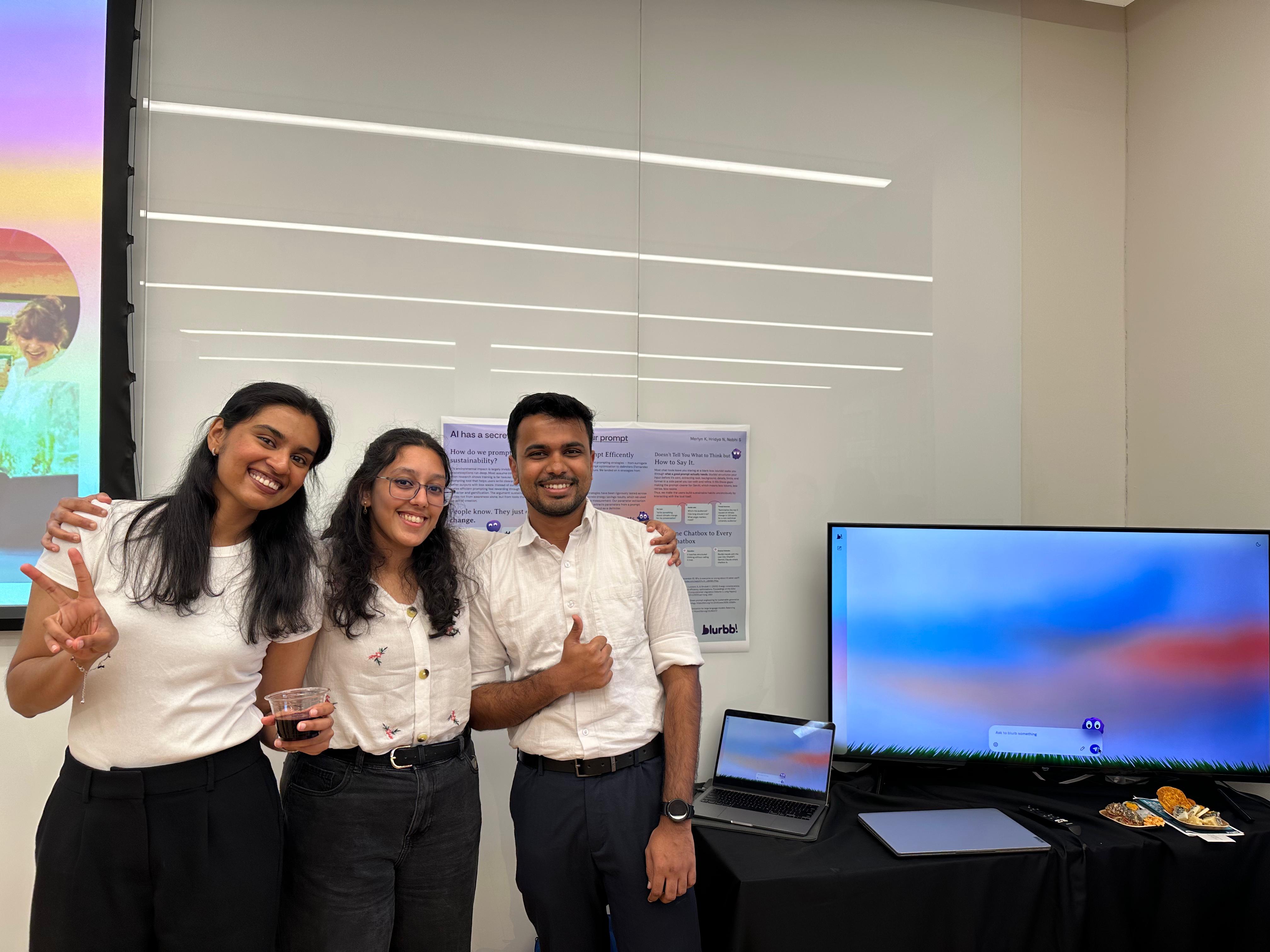
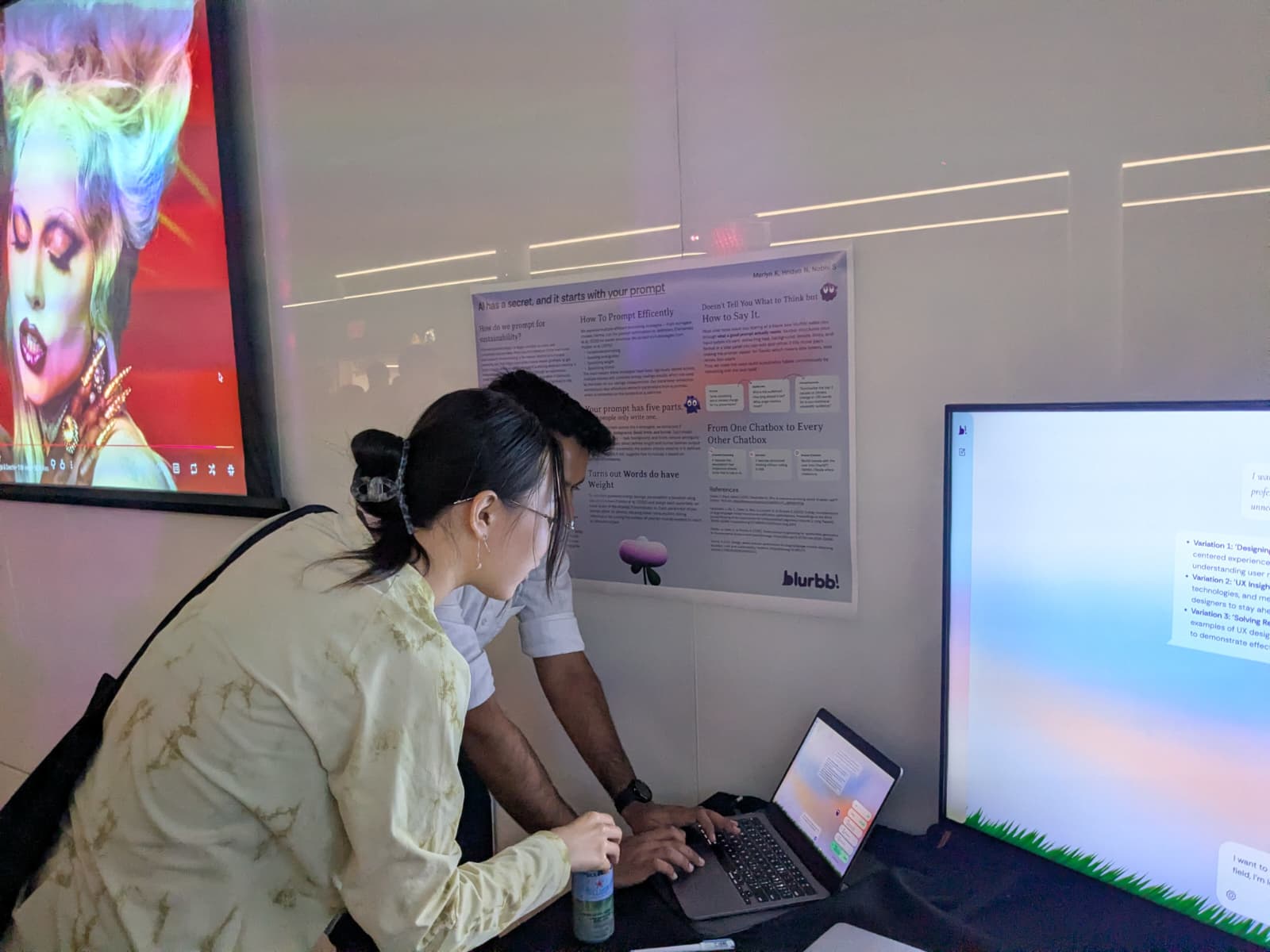
The product launched live and was presented at Pratt's Infoshow '26, where it resonated immediately with attendees validating that the tension I'd found in my original research wasn't unique to students, but a broader, largely unaddressed gap in how people relate to AI.
Project Takeaways
A stab in the dark
Sustainability in AI is a genuinely hard, unsettled problem. Regulation hasn't caught up, and the technology itself is still moving too fast for anyone to claim they've solved it. It was our attempt to show the space deserves real design attention, not just policy debate.
AI builds faster but it doesn't necessarily design better
AI made execution faster, but it didn't make the thinking easier — if anything, it raised the bar. Creative judgment, taste, and craft became more important through this project. Moodboarding, wireframing, and mocking up by hand before bringing AI into the build process is what kept blurrb! from looking like every other AI interface out there.
Even hard problems deserve a little whimsy
Blurrb's interface pulls its visual tone from an unlikely place: Zara Larsson's Midnight Sun. Letting the design have a little fun was as deliberate a choice as anything else in this project. This project really reflects my vision as a designer and I'm glad I stuck to my instincts.