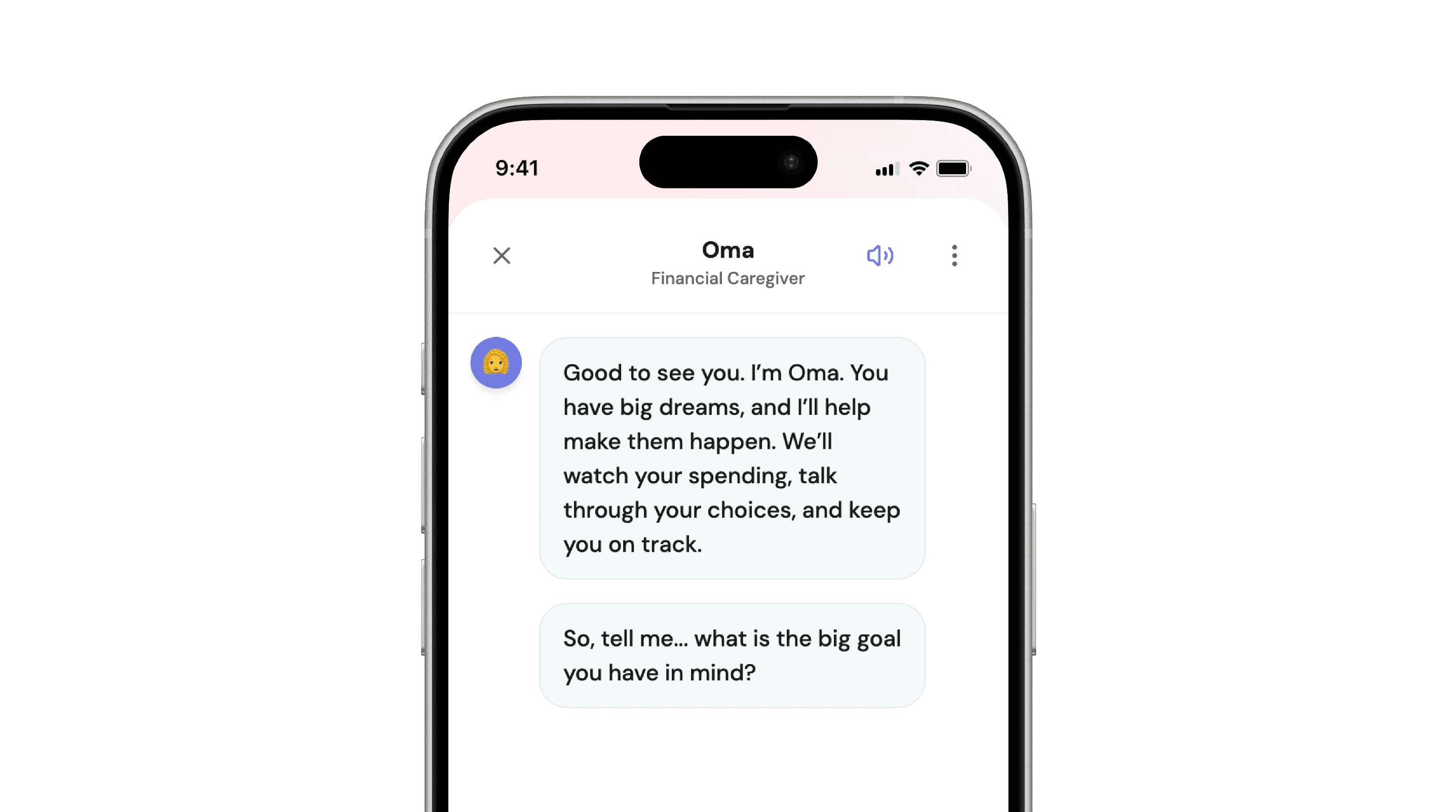
Oma: A conversational budgeting chatbot that intervenes in the moment of impulse & not after the damage is done.
MY ROLE
Conversational UX Designer
TEAM
Conversational UX Designers, Team Lead
DURATION
6 Weeks (Apr 26 - May 26)
TOOLS
Figma, Figma Make, Claude, ElevenLabs, G-Suite
MY RESPONSIBILITIES
Personality & Tone Design, Voice & Language Options, Happy Path, Presentation Narrative
Context
Why budgeting fails for people?
Most people don’t fail at budgeting because they don’t understand money. They fail in the moment. 89% of shoppers have a history of impulse buying, and 54% have spent $100 or more on a single impulse purchase. Budgeting apps are everywhere and they’re full of charts, categories, and progress bars. But none of them are there when you’re standing in a store at 11pm convincing yourself you need something you absolutely do not need.
The problem isn’t data. It’s accountability.
Financial dashboards can show you what you spent, but they can’t respond to what you’re about to spend. There’s no reaction, no pushback, no one to disappoint. The most effective check on behavior isn’t an algorithm, it’s a person who cares.
Goal
How might we intervene in moments of impulse spending with guidance that feels supportive, human, and hard to ignore?
Conversational Design
Why Conversation and not another Dashboard?
Before committing to a chatbot, we tested that assumption against Google's conversational design framework instead of defaulting to it. Budgeting failure is a moment-of-decision problem, not an information problem. Users already know their balance and their goal. What they lack is a voice pushing back in real time, and no dashboard can do that. Every one of Oma's three core features was validated against this framework before we built it, confirming conversation was necessary.
Meet Oma
Oma is a conversational budgeting assistant that acts like a caring but honest mom — helping you stay accountable to your financial goals. She’s not a dashboard. She doesn’t show you a pie chart. She talks to you in the moment of the decision, reminds you what you said you wanted, and holds her position even when you try to argue.
Oma is designed for people who have long-term financial goals but struggle to follow through in the moment who want someone to talk to before making a purchase, and who need accountability that feels like support, not surveillance.
But why the name Oma?
The name is intentional. Oma means grandma in German, mom in Korean (Umma), and mother in many South Asian languages (Amma). Across cultures, it's the person who worries about you and tells you the truth whether you ask or not. That's exactly who this bot is.
Oma’s core experience is built around three features, each validated against Google’s conversational design framework to confirm that conversation was actually the right modality — not just a fun idea.
The Experience
Onboarding — Setting a Goal
Oma gets to know you. She asks for your financial goal, your timeline, your income, your monthly expenses and then sets a monthly savings target. From that point on, every conversation is anchored to that goal.
Feature 1 — Log an Expense
Users can log spending through chat or voice. Oma automatically categorizes the expense, shows how it lands against the monthly goal, and gives immediate feedback as a reaction. The friction of navigating to a form is exactly what makes people stop logging. One message removes that friction entirely.
Feature 2 — Ask Before You Buy
This is the core feature — the intervention that makes Oma different from every other budgeting tool. Before a purchase, the user tells Oma what they want to buy and how urgent it feels. Oma assesses it against their goal: need vs. want, urgency, remaining budget and gives a clear recommendation with a reason. The Yes path logs the expense and reflects it on the dashboard. The No path gives alternatives and holds the position. A form can’t say “didn’t you just buy one last month?” Oma can.
Feature 3 — Progress Check-In
Users can check in anytime to see their monthly savings, progress toward the long-term goal, and remaining flexible budget. Oma gives short, goal-focused feedback. Financial check-ins are inherently conversational. Numbers alone don’t motivate.
Designing the Personality
The biggest design challenge wasn’t the flows or the features. It was the voice. Getting Oma’s personality right meant finding the exact line between warmth and authority; close enough to feel caring, firm enough to actually work.
We debated going sassy or strict. But we quickly recognized that people have very different relationships with parental figures, and a tone that felt motivating to one person could feel punishing to another. So we landed on a tone formula that every response follows:
Acknowledge → Reality → Redirect.
Every response validates where the user is, grounds them in the facts, and points them somewhere better. Firm but supportive. Accountability without judgment.
Six communication strategies anchor every line Oma says:
Future-First Thinking: “Future You will thank me, even if Current You is annoyed.”
Strategic Guilt: “Just keep an eye on the small things. They add up faster than you think.”
Calm Disapproval: “You can do better than this.”
Meaningful Approval: “Good decision. That’s the kind of focus I like to see.”
Practical Over Emotional: “Stress doesn’t make the price tag any smaller.”
Financial Wisdom Framing: “Money is freedom. Don’t trade it too easily.”
Voice & Language Options
Not every mom sounds the same
During testing, it became clear that people had strong opinions about how Oma should talk. Some wanted warmth, some wanted tough love, some just wanted the facts. I led the design of three voice modes built with ElevenLabs — so users could choose a version of Oma that felt right to them:
Warm — calm and nurturing, gentle pacing.
Neutral — clear and grounded.
Strict — direct and firm, but still caring.
Voice was also a deliberate modality choice: hearing “didn’t you just buy one last month?” hits differently than reading it. But money is personal. In public on the subway, at work, text gives you the same Oma without the audience.
What Makes Oma Different
Most budgeting tools treat money as data: spend less, save more, stay on track. Oma treats it as behavior.
She remembers what you said you wanted.
She talks to you in the moment of impulse.
She holds you accountable like someone who cares.
The goal goes beyond budgeting. We don’t just want users to track expenses but we want to change how they relate to money. Oma is designed to normalize financial conversations, reduce shame around spending habits, and encourage reflection instead of avoidance. We want money to feel like something you can talk about, not something you avoid.
Project Takeaways
Designing Oma’s personality was harder than designing her flows.
Getting tone right in conversational UX isn’t a copy decision — it’s a design decision. Every word Oma says either builds trust or breaks it. Too warm and she has no authority. Too strict and users tune her out. The six communication strategies we built weren’t just writing guidelines; they were design constraints that kept every response consistent, no matter the situation.
Personalization in conversational AI is about changing how it feels to be talked to.
Same values, different delivery. That distinction matters a lot when the topic is something as emotionally loaded as money.
In conversational design, you control what they hear, when they hear it, and how it makes them feel
as compared to visual design, where you control what users see. That’s a completely different muscle and one I’m glad I got to build.