Office of Research and Strategic Partnerships
Making Research Support Processes Easier to Navigate
ROLE
Service Designer
TEAM
Service Designers, Admin and Ops Coordinator,
Research Development Specialist, Grant Writer & Administrator
DURATION
9 Weeks (Oct 25 - Dec 25)
TOOLS
Service Blueprint, Co-Design Workshops, FigJam, Figma, Zoom, G-Suite
RESPONSIBILITIES
Conducted service safaris and planned and facilitated a co-design workshop, including activity design and participant recruitment; synthesized qualitative data into key insights; and developed faculty archetypes to guide service design decisions.
Context
Who is ORSP?
The Office of Research and Strategic Partnerships supports faculty throughout the research life cycle by identifying funding opportunities, guiding project discovery and development, assisting with proposal writing and budgeting, ensuring compliance and IRB review, and managing post-award processes.
Why they asked for help?
The Office of Research and Strategic Partnerships (ORSP) identified that faculty struggled to navigate the project development process, particularly following recent updates to procedures and digital resources. Faculty with varying experience levels found the Project Development webpage and flowchart difficult to interpret, as they condense a complex, multi-stage process into a single communication tool.
The goals of this project were to (1) improve ORSP-to-faculty communication by clarifying the project development process and making procedures and resources easier for faculty to navigate, and (2) define faculty archetypes to strengthen ORSP’s support of Pratt faculty in future engagements.
Value-Exchange in the Ecosystem
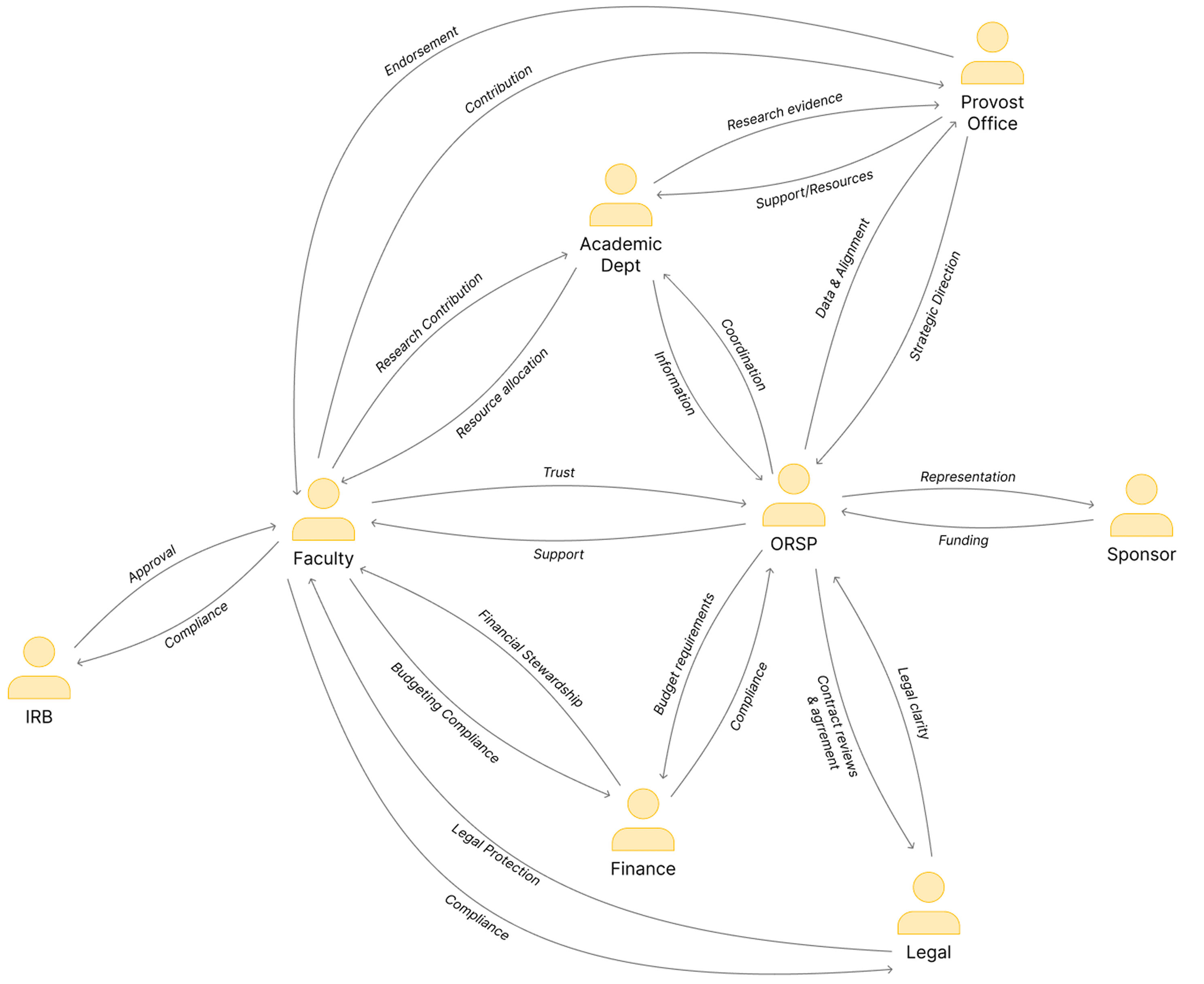
ORSP - Faculty Ecosystem Loop
Pratt’s research ecosystem is a network of people and departments that exchange value to support research. Faculty contribute ideas and innovation, while ORSP coordinates the process and provides guidance across the research lifecycle.
Finance, Legal, and the IRB ensure budgeting accuracy, institutional protection, and ethical compliance, with oversight from Academic Departments and the Provost’s Office. ORSP translates these requirements into clear, actionable steps for faculty and manages relationships with external sponsors, who provide funding.
Together, these exchanges form a self-sustaining research ecosystem.
Workshop in-action
To better understand faculty needs, we conducted a series of co-design workshops. Co-design is a participatory approach in which people directly impacted by a service actively contribute to shaping solutions, rather than serving only as research subjects.
In this project, Pratt faculty collaborated with the team to explore how communication between ORSP and faculty could be improved. We facilitated 4 co-design workshop sessions over 2 weeks, guided by the following goals:
Understand how faculty define their research personalities at Pratt.
Identify the challenges and needs at each stage of research development.
Co-create ideas for better communication experience with ORSP in the future.
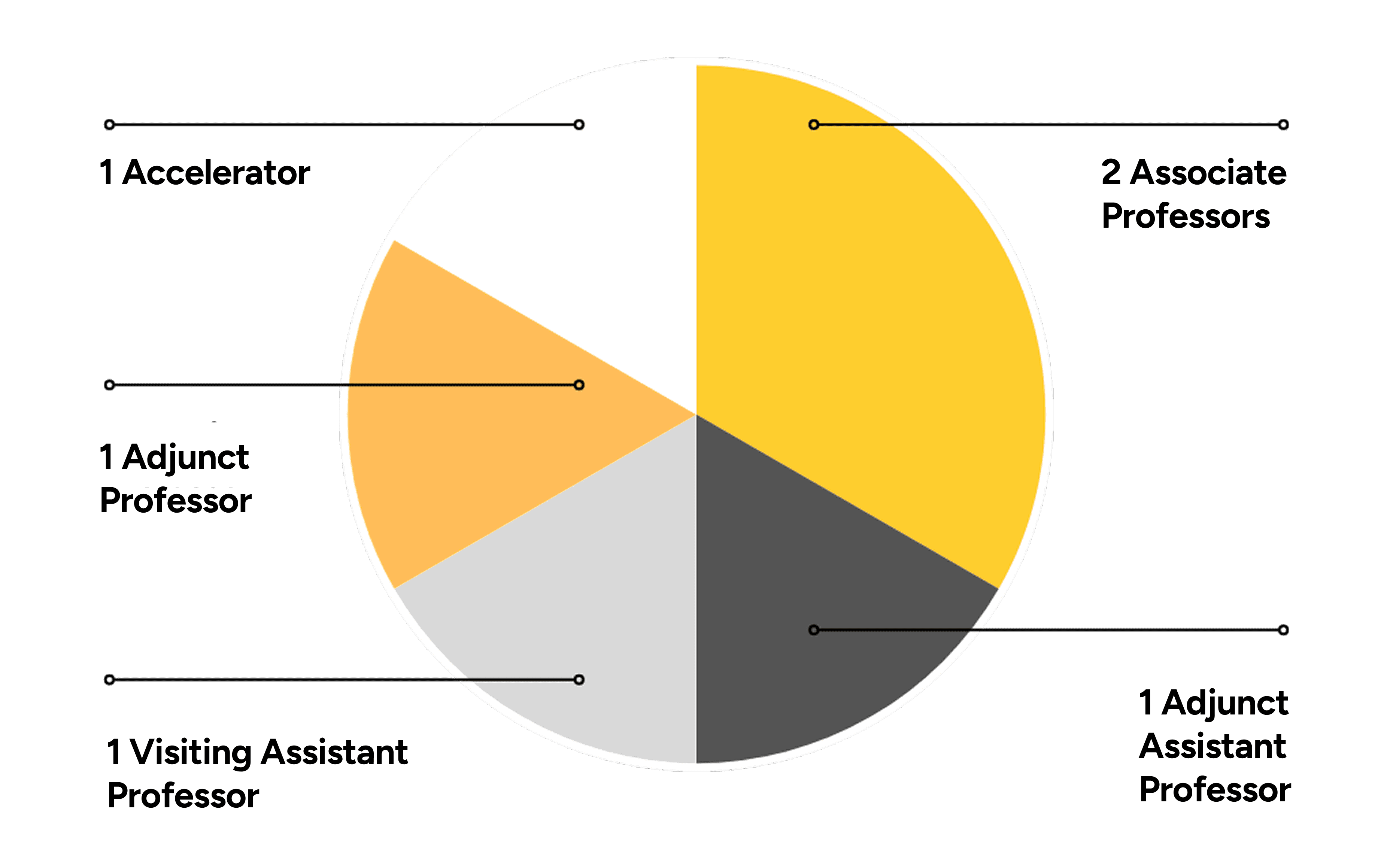
Demographic of Participants
Activity 1 - Research Persona Mapping
Goal: To help faculty reflect on and define their identities as researchers.
Participants received a blank template and a set of research-focused prompt cards to visualize their research identity. This activity enabled participants to externalize both their professional and emotional relationship with research, setting the foundation for the activities that followed.
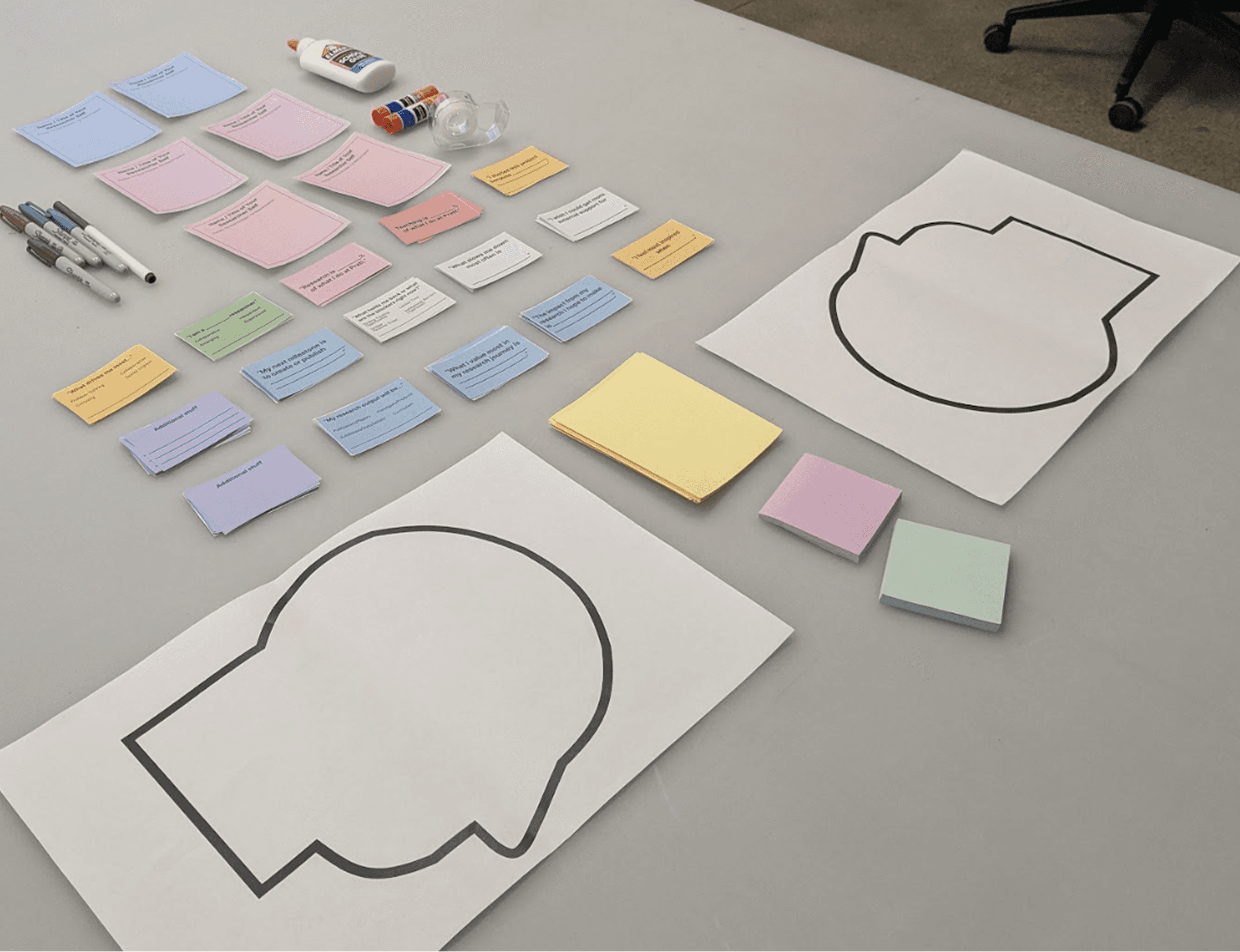
Materials for Activity 1
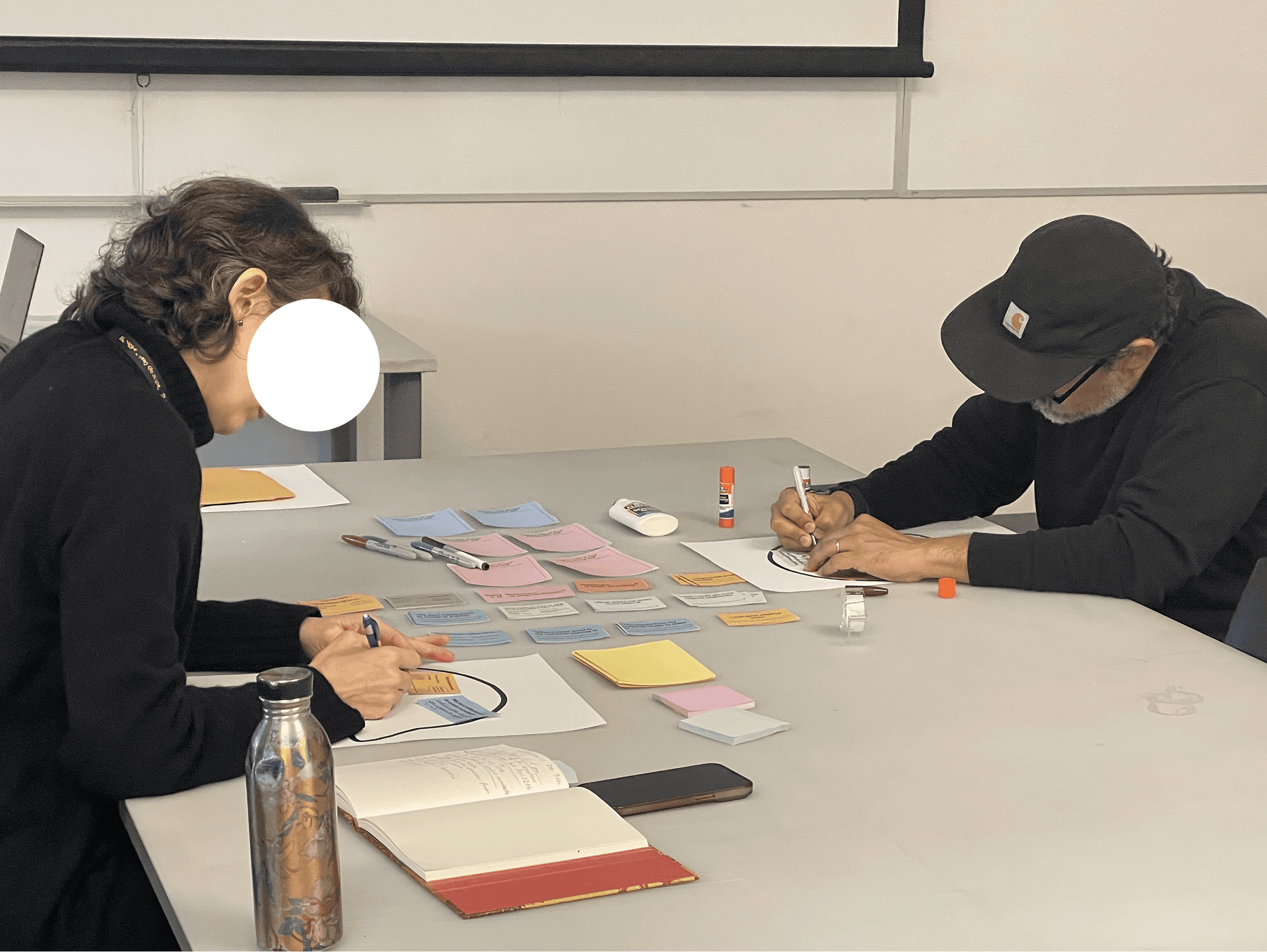
Participants doing the activity
Activity 2 - Research Journey Co-Creation
Goal: To identify faculty needs and challenges during research development and co-create ideas for leveraging ORSP’s support across key stages.
We guided participants through a scenario prompt based on their experiences working with ORSP. For each stage of the research journey, participants mapped challenges and needs, as well as preferences and ideas for improved support.
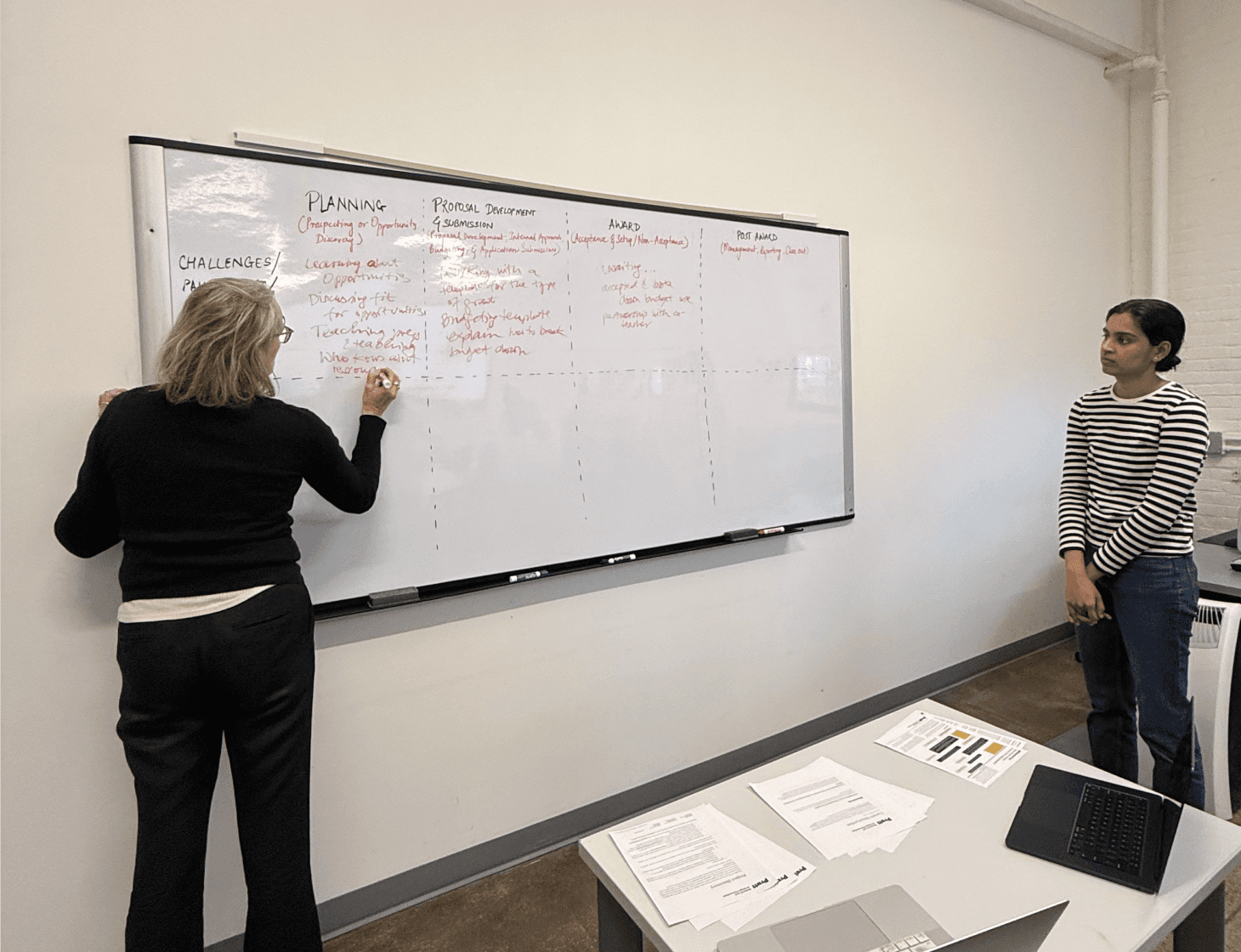
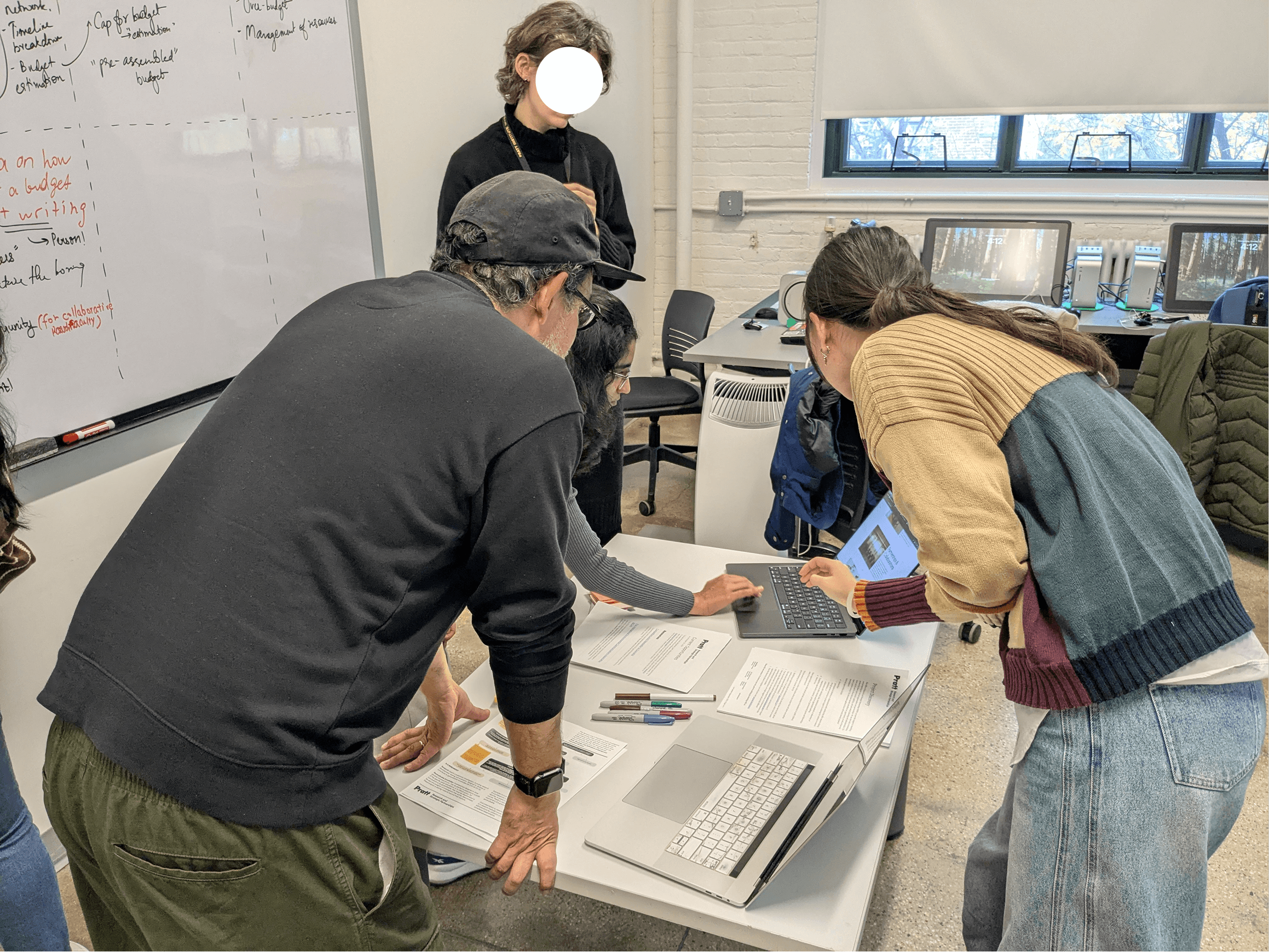
Participant and Facilitators brainstorming for Activity 2
Identified Issues
Lack of Awareness & Difficulty in Navigating Pratt’s available Institutional Resources for Research Development Support
Need for Enhanced Guidance in Positioning Art-Based and Intersectional Research Work and Outcomes Within Formal Research Frameworks
Difficulty Identifying Collaborative Partners and Navigating Funding Opportunities
Need for more simplified budgeting tools and Enhanced Support for other Administrative Tasks
Desire for stronger institutional recognition, acknowledgement and increased visibility of their research contributions.
Faculty Archetypes
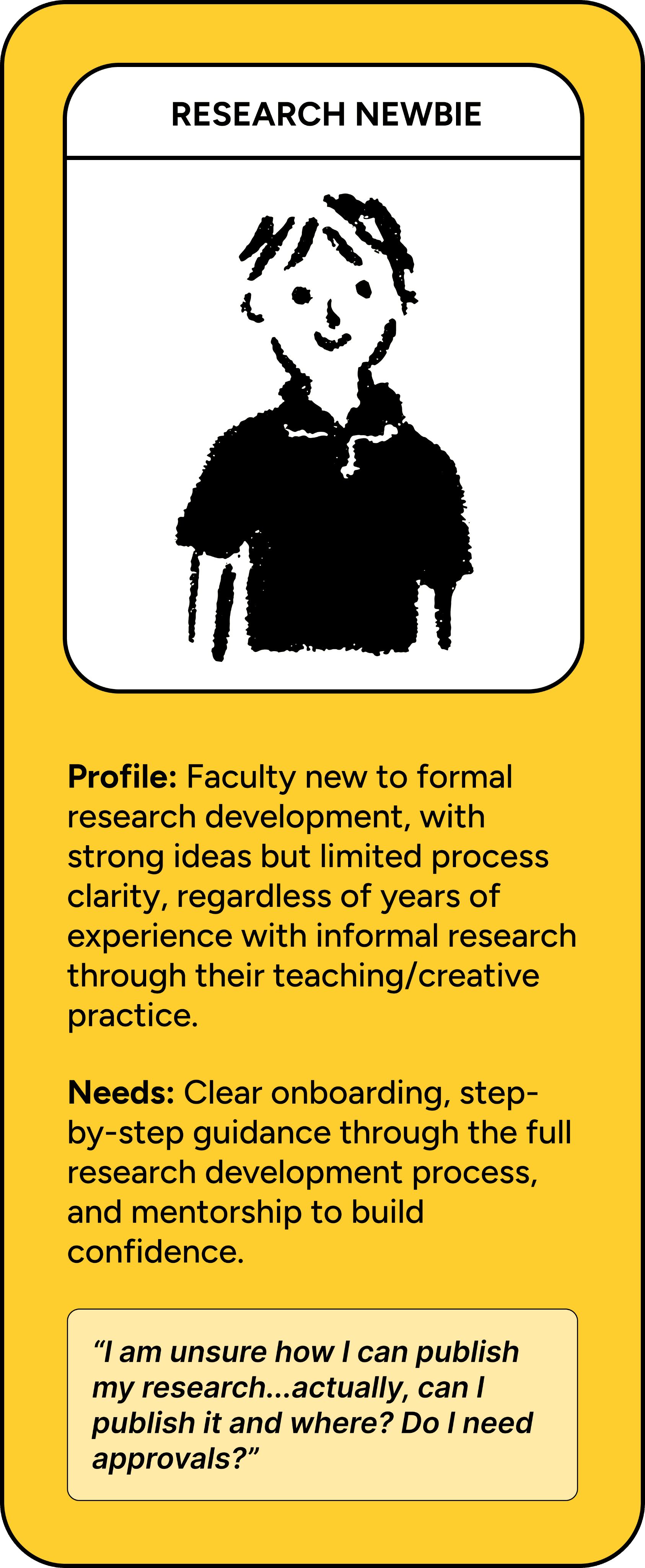
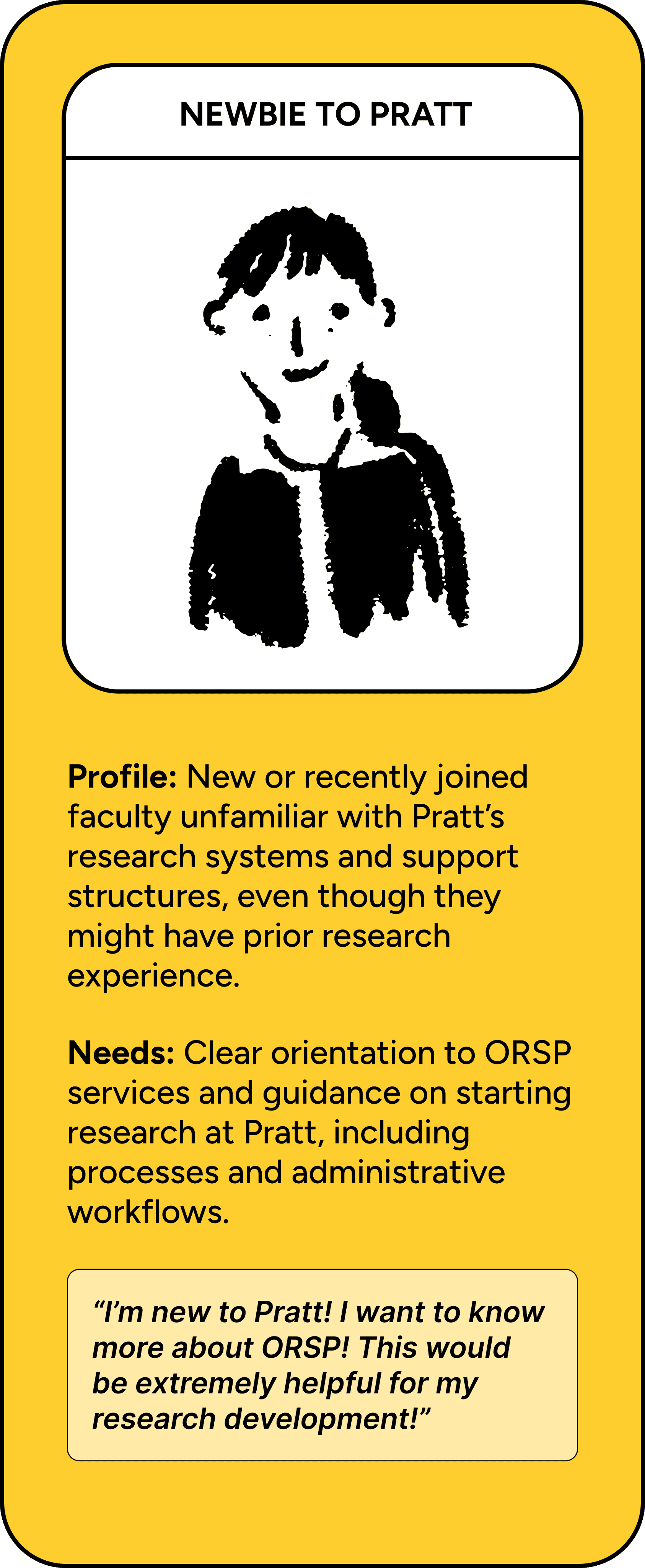
Archetypes are representative profiles that capture common behaviors, goals, needs, and challenges across faculty. Rather than depicting individuals, they reveal patterns in how Pratt faculty engage with research.
Understanding these archetypes helps ORSP tailor communication and support to better meet faculty needs.
How to use the archetypes?
Profile: Key characteristics of each faculty type
Needs: Targeted support required from ORSP
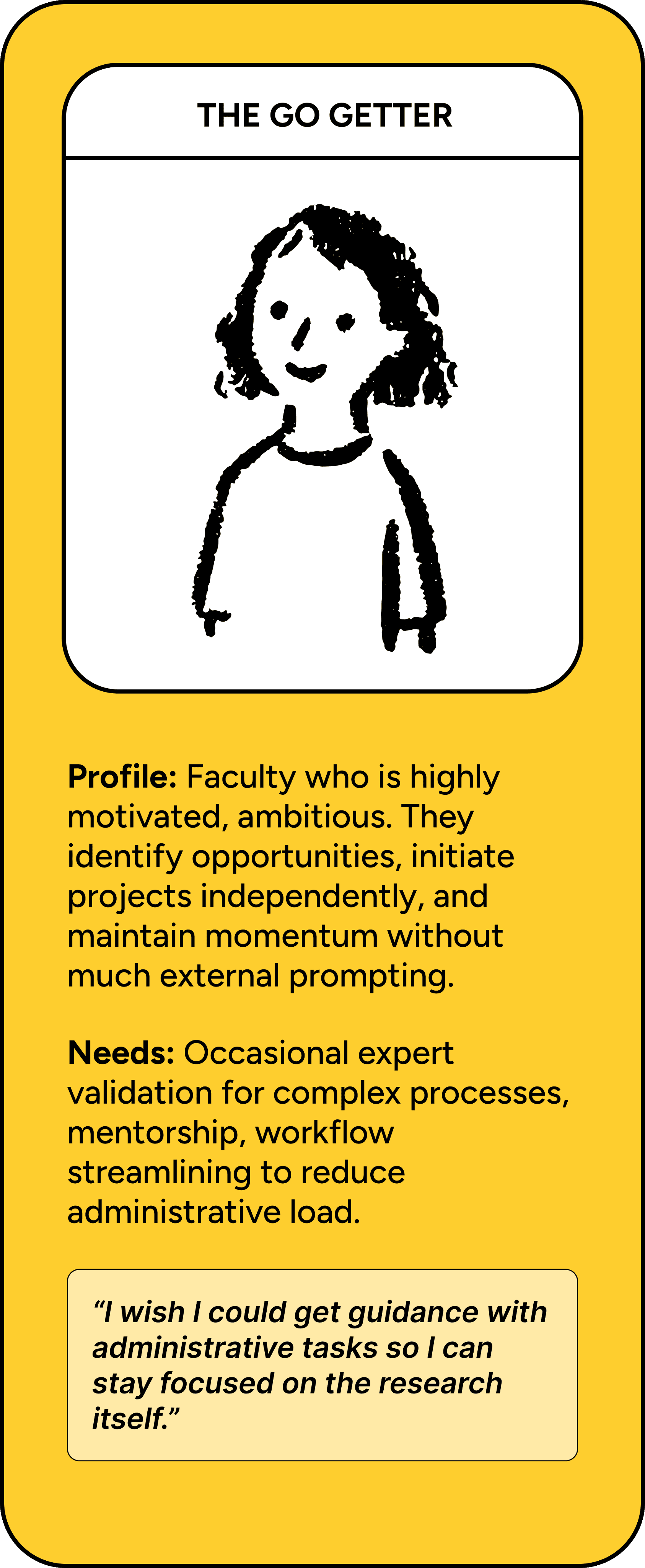
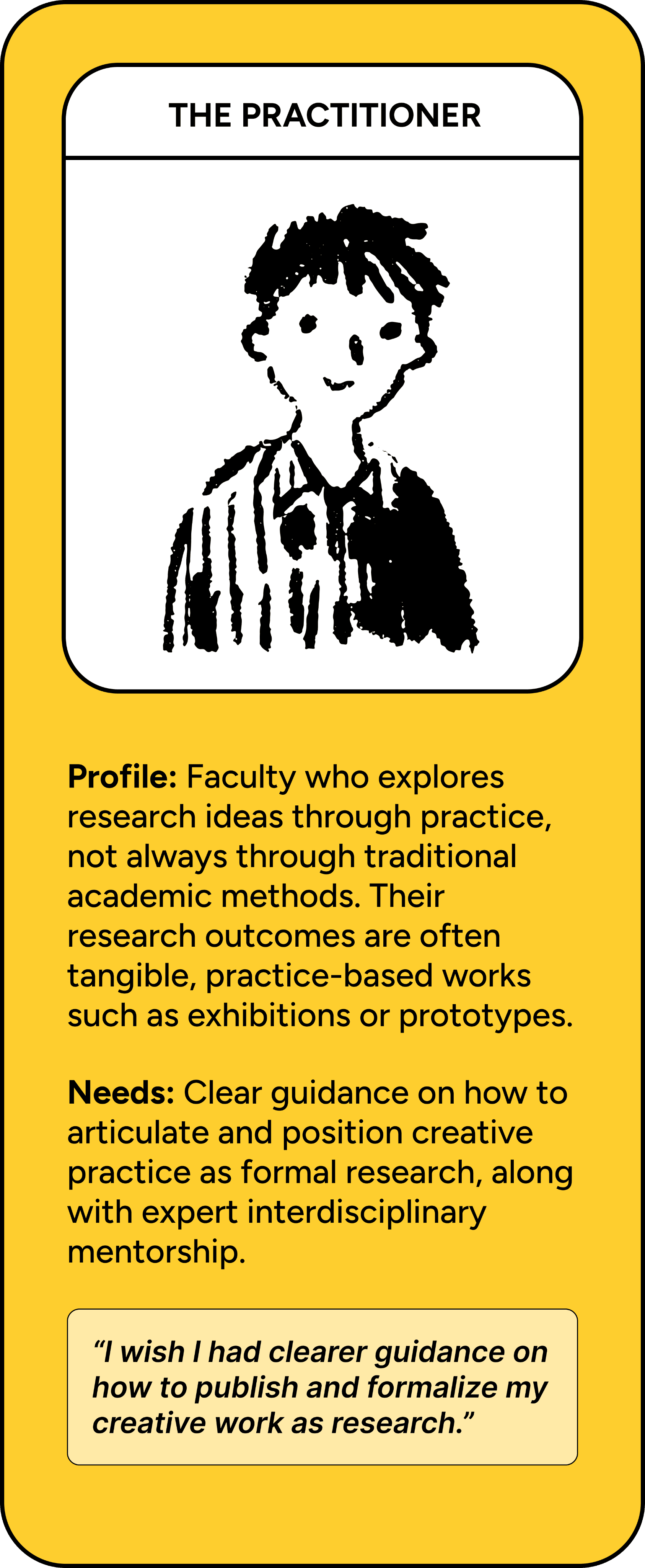
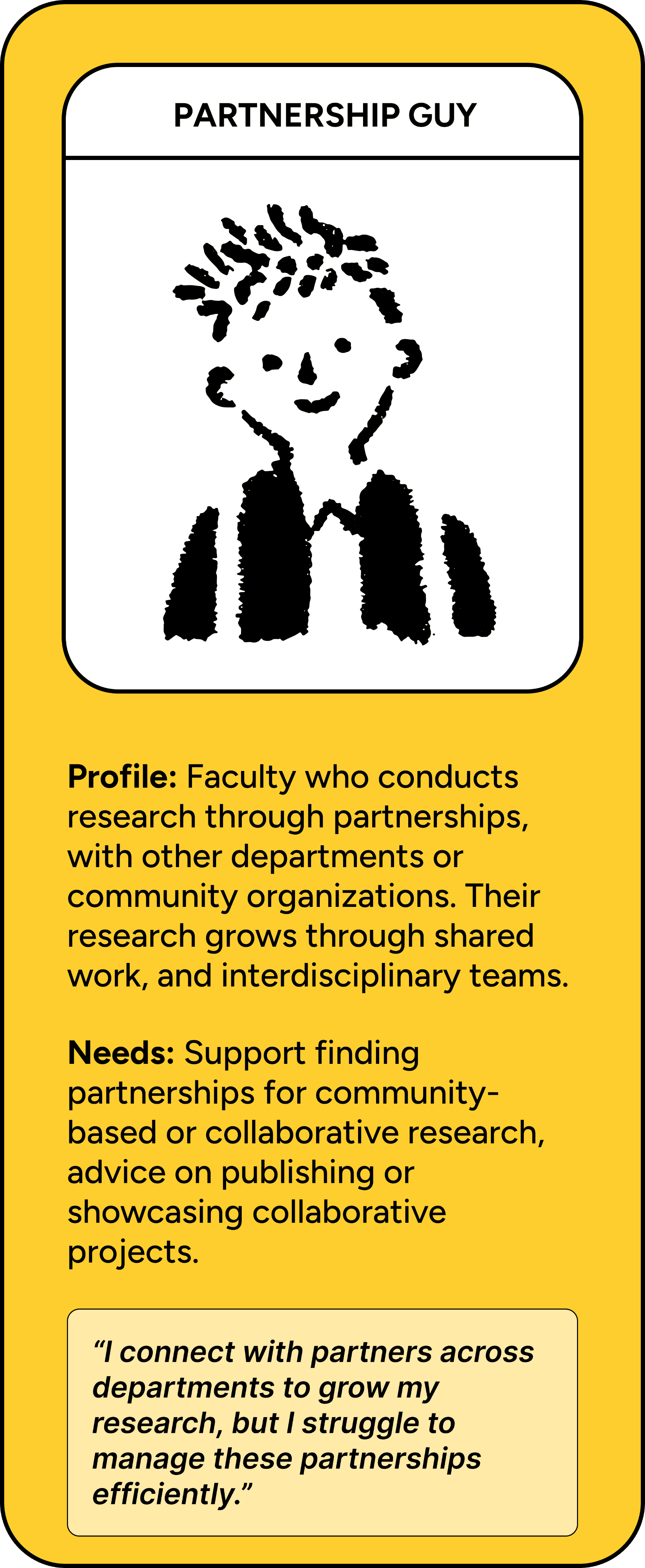
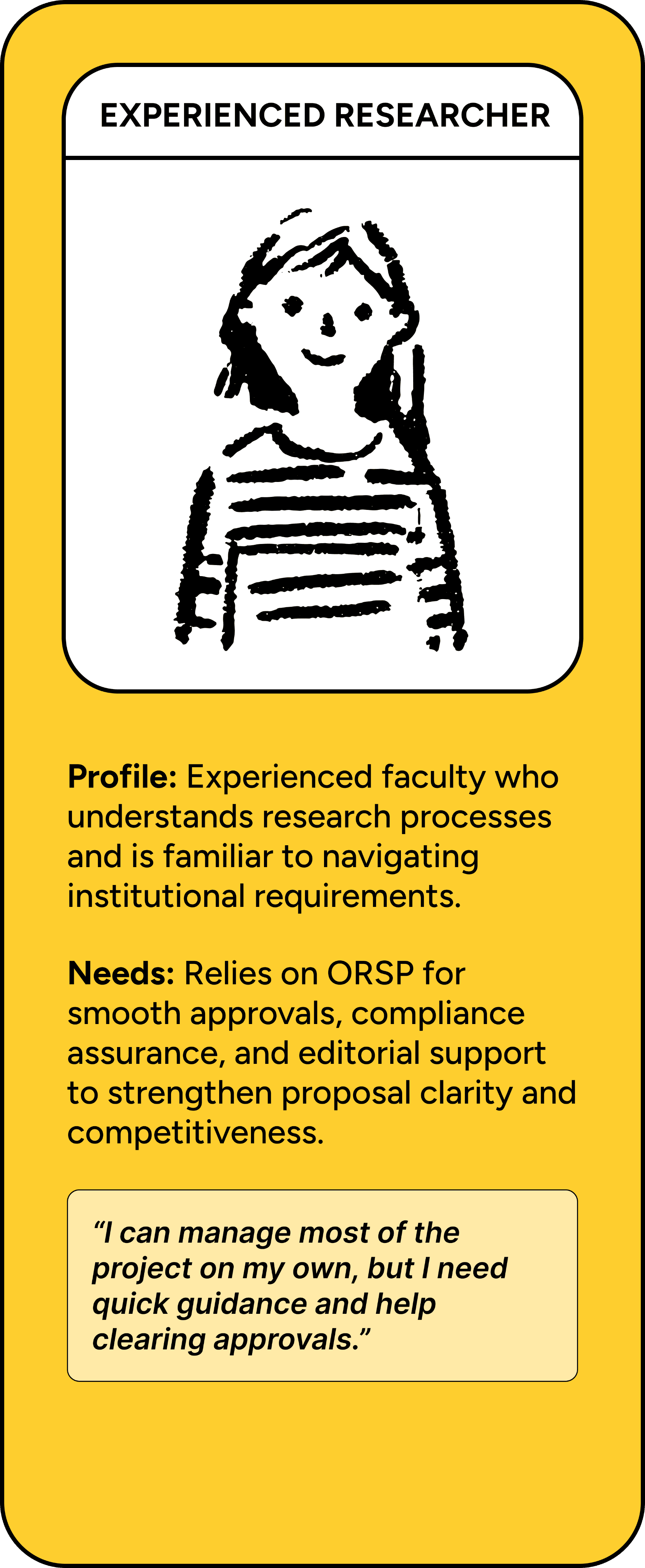
Design Interventions
Building on insights from the co-design workshops, we collaboratively generated opportunities with faculty to improve how ORSP communicates with and supports them. These ideas were shared with the ORSP team in a feedback session to validate findings and refine direction. Based on this input, concepts were synthesized into two final intervention themes, prioritized below.
Intervention Theme 1: Visibility
Focused on improving the discoverability of ORSP services and clarifying processes and resources.
Intervention 1: Getting to Know ORSP Better
Intervention Theme 2: Support Enhancements
Aimed at strengthening guidance, onboarding, and hands-on support across stages of the research journey.
Intervention 2: Landing Page Redesign for Easier Information Access
Intervention 3: Structured Appointment Scheduling & Faster Information Retrieval
Getting to know ORSP (Better)
A series of ORSP-led events designed to increase faculty awareness of research support services at Pratt.
Connected to
Insight 1: Lack of Awareness & Difficulty in Navigating Pratt’s available Institutional Resources for Research Development Support
Insight 3: Difficulty Identifying Collaborative Partners and Navigating Funding Opportunities
Insight 5: Desire for stronger institutional recognition, acknowledgement and increased visibility of their research contributions.
These insights highlight the need for stronger communication, visibility, and connection points between ORSP and faculty.
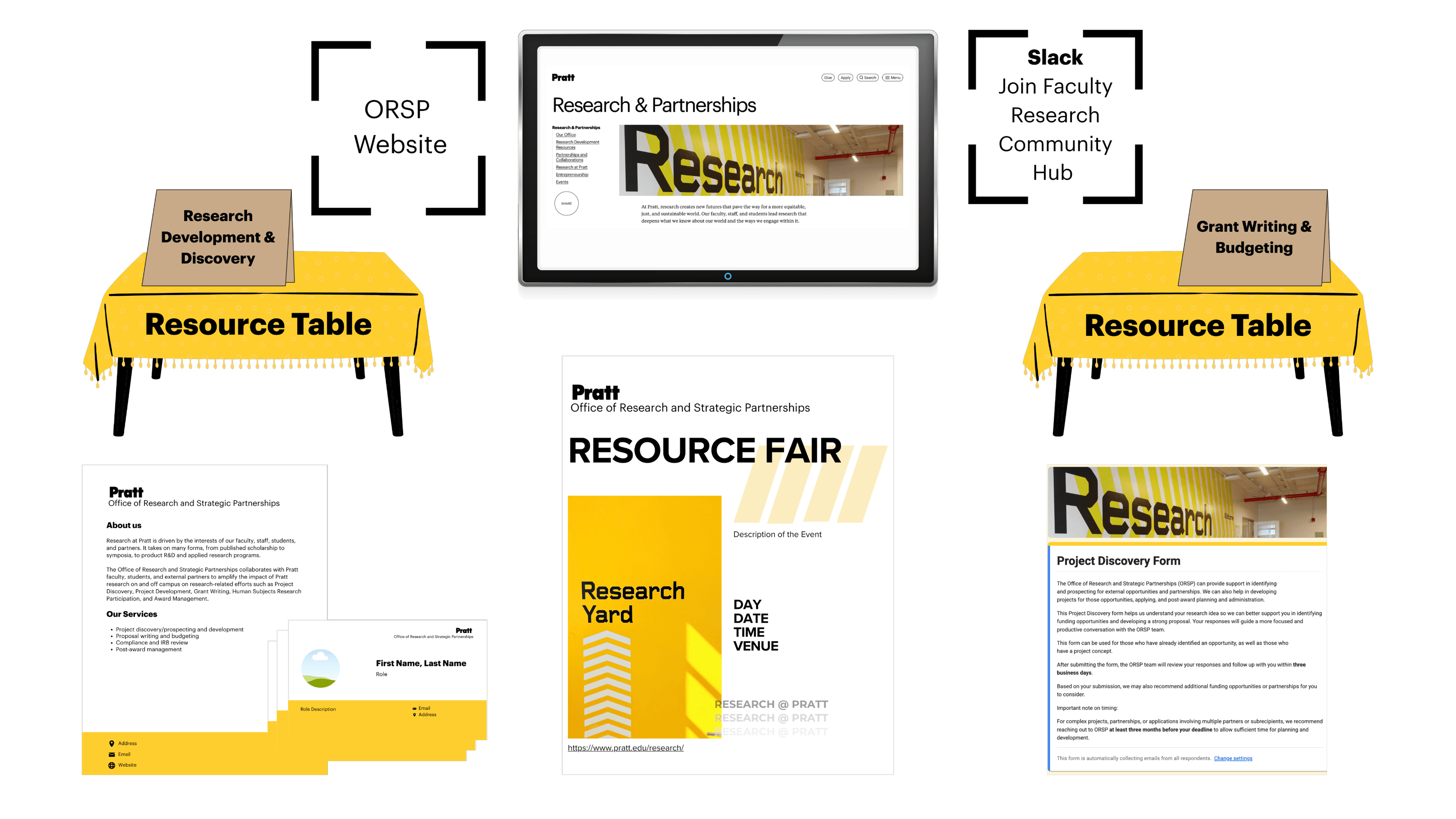
Event 1: ORSP Resource Fair
Priority: High
A semesterly institute-wide event to increase faculty understanding of ORSP services, create an approachable space for questions, and encourage cross-departmental networking.
Target Archetypes: New to Pratt, Research Newbie, and Go-Getter
Implementation:
Locations: Brooklyn and Manhattan campuses
Timing: Early semester, high-traffic periods
Promotion: Flyers in lounges, hallways, Brooklyn Navy Yard; email campaigns including newsletter feature and staged reminders
Event 2: IDC Accelerator Ambassadors - Departmental Research Showcase Series
Priority: Medium
An annual or recurring departmental showcase where IDC Accelerator alumni present their research journey and outcomes.
Goals:
Celebrate faculty achievements
Increase visibility of ORSP’s support
Foster collaboration, mentorship, and a research culture
Target Archetypes: Partnership Guy, Practitioner
Implementation:
Coordinate with departments and supporting offices
Feature presentations, posters, or informal talks highlighting research focus, ORSP resources used, and future directions
Capture insights for ongoing records and future improvements
Landing Page Redesign for Easy Information Access
Priority: Medium
Redesign ORSP’s landing page into an onboarding hub that helps faculty quickly understand and navigate resources according to their research stage and goals.
Connected to:
Insight 1: Lack of Awareness & Difficulty in Navigating Pratt’s available Institutional Resources for Research Development Support
Insight 5: Need for more simplified budgeting tools and Enhanced Support for other Administrative Tasks
Target Archetypes: Newbie to Pratt, Research Newbie, Go-Getter
Workshop feedback revealed that faculty especially Research Newbies and those New to Pratt—often feel overwhelmed by the current website, creating a steep learning curve. The Go-Getter archetype experiences friction and delays due to the cluttered interface.
Goals:
Improve faculty understanding of ORSP services
Reduce navigation barriers and streamline access to resources
Enable ORSP staff to focus on high-value support
Key Features / Implementation:
Contact ORSP Shortcut: Directs faculty to a simplified Project Discovery Google Form to ask questions or share needs quickly.
Prominent CTA Buttons: Guides faculty to relevant resources based on the prompt “What are you trying to do?” For example:
“I want to apply for a grant” → grant application guidelines
“I need help with budgeting” → budgeting resources and templates
“I need help with grant writing” → grant writing resources
Clicking a CTA leads directly to the relevant guidance page, reducing navigation time and cognitive load.
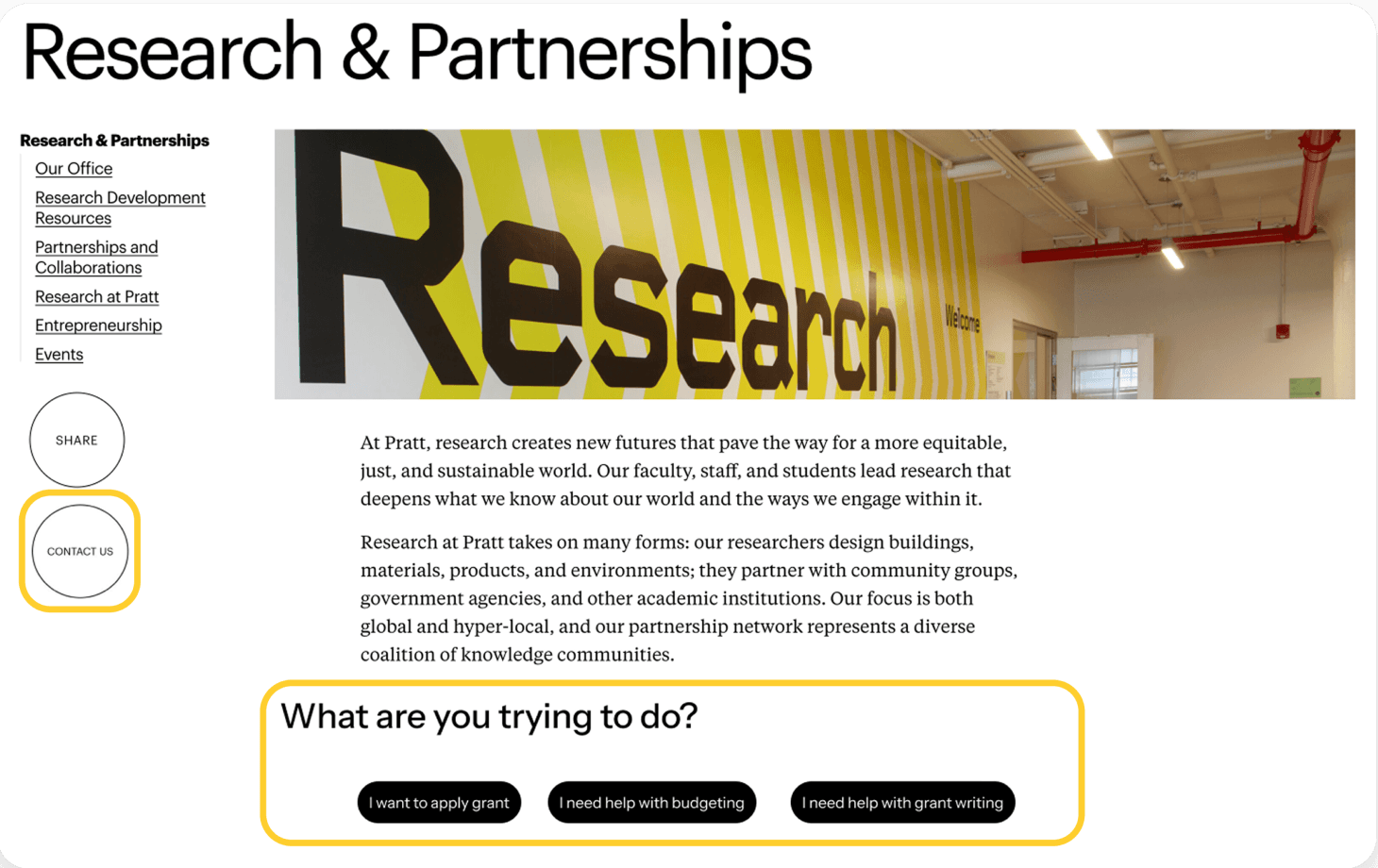
Website Mockup
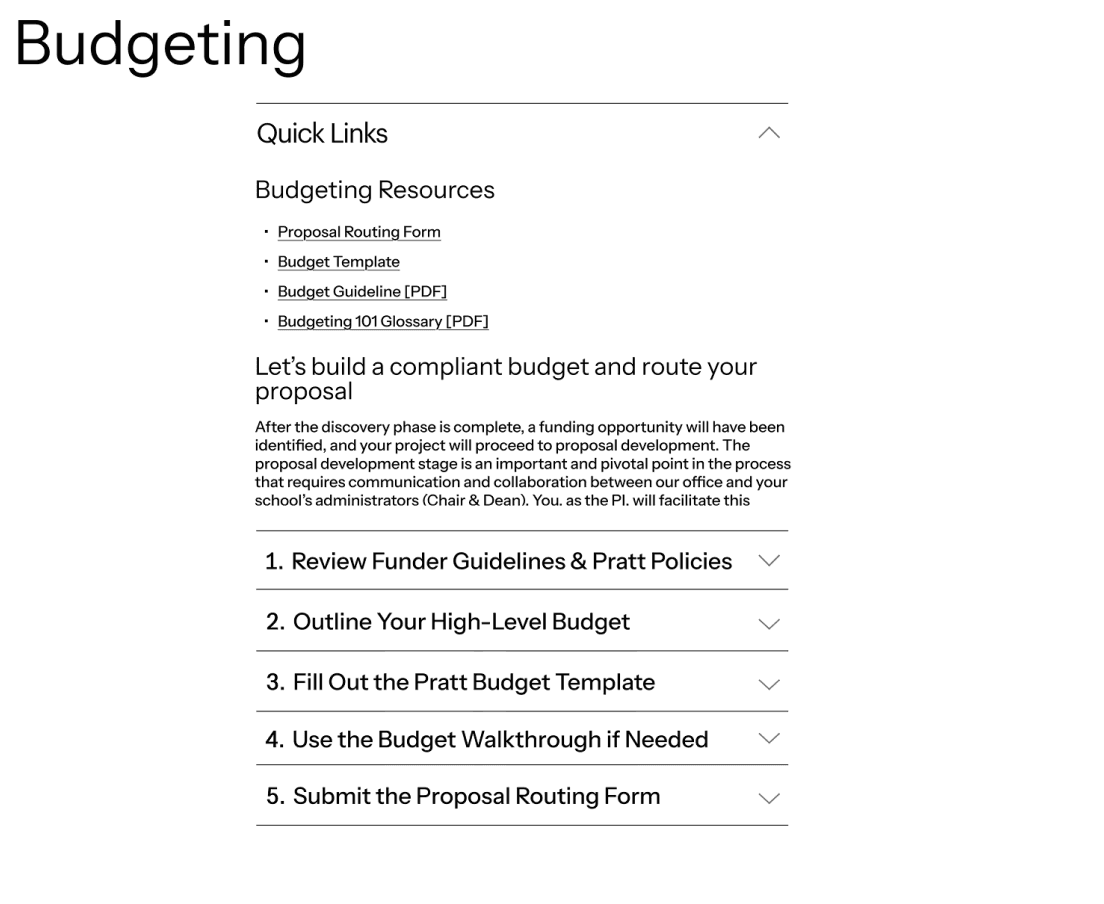
Website Mockup
This intervention transforms the ORSP webpage from a static information archive into a guided, user-centered hub. It reduces repetitive questions, allows staff to focus on higher-value support, and serves as a central tool for improving faculty communication.
Regulated Appointment Scheduling & Faster Information Retrieval
This intervention simplifies appointment scheduling and access to research support, combining a streamlined booking system with a virtual assistant inspired by the Pratt Institute Library’s navigation and support structures.
Connected to
Insight 4: Need for more simplified budgeting tools and Enhanced Support for other Administrative Tasks
Faculty often face difficulty finding information, unclear contact points, and inefficient scheduling. This intervention standardizes intake, reduces repeated outreach, and ensures faster, more consistent support for all 6 faculty archetypes.
Calendar Invite Appointment Scheduling System
Priority: High
A simplified, automated system routes faculty to the appropriate ORSP staff and eliminates back-and-forth emails.
How it works:
Faculty click the “Contact Us” button on the ORSP site, leading to a simplified Project Discovery Google Form.
Requests are automatically routed to the correct ORSP staff member for approval.
Approved meetings generate an automated calendar invite; declined requests include a brief explanation and, when relevant, next steps.
This process reduces administrative workload, ensures faculty are well-prepared for consultations, and streamlines scheduling.
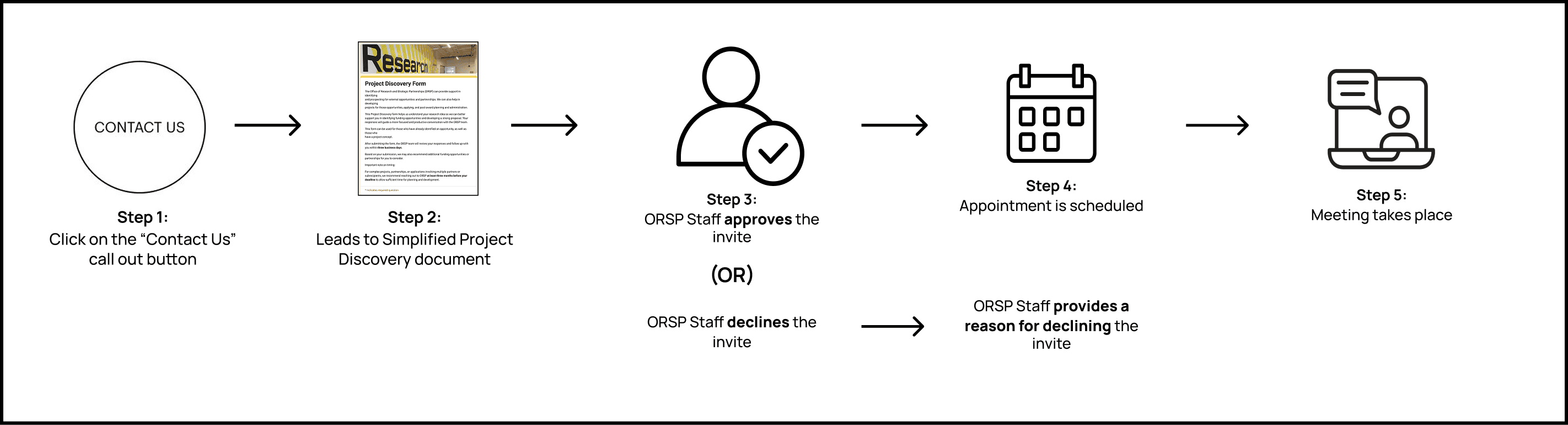
User flow for Appointment Scheduling System
ORSP Virtual Assistant
Priority: Low
A conversational chatbot provides quick access to research information or helps faculty schedule appointments.
How it works:
Accessible from the ORSP webpage, the chatbot offers two options: “Research Support Information” or “Schedule a Meeting.”
For research support, it delivers relevant guides, templates, and policies instantly.
For scheduling, it guides faculty to the booking system and routes requests automatically to the right staff, following the same approval flow as the calendar system.
This approach reduces cognitive load, ensures accurate information, and creates a clear, efficient path to support.
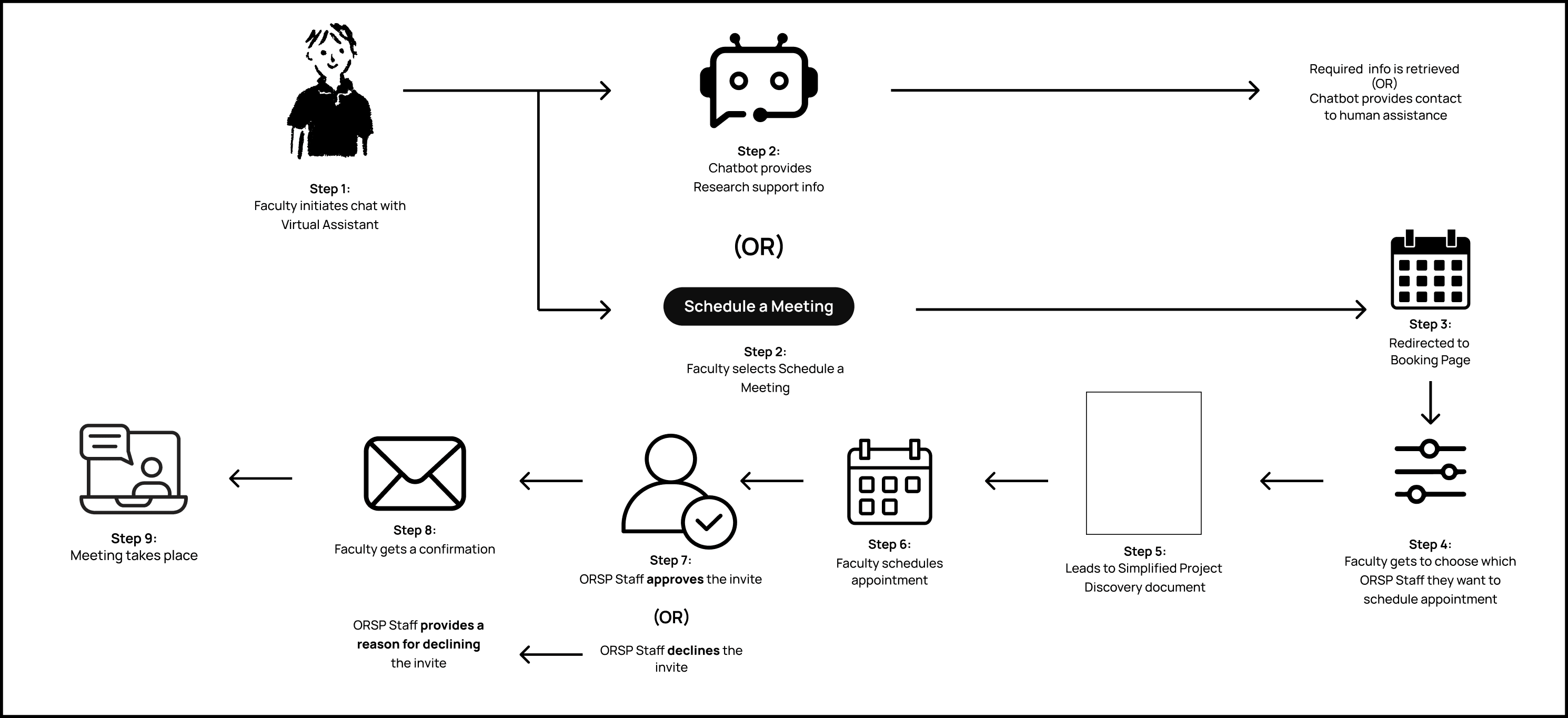
User flow for ORSP Virtual Assistant
Future Consideration: As faculty research needs diversify, expanding the virtual assistant could further personalize guidance and support.
How can ORSP strengthen its capacity to support art-based and intersectional research?
Across all faculty archetypes, a consistent theme emerged: Pratt’s research identity is increasingly shaped by art-based, hybrid, and intersectional work, yet faculty lack clear guidance on framing this work within traditional research structures. This gap creates friction in proposal development, hiring, evaluation, and long-term faculty success.
Connected to
Insight 2: Enhanced Guidance in Positioning Art-Based and Intersectional Research Work and Outcomes Within Formal Research Frameworks
ORSP should hire or appoint a specialist in art-based, practice-led, and intersectional research methodologies to expand expertise and guidance.
Why This Matters:
Protects faculty success and strengthens hiring competitiveness
Anchors Pratt’s creative research identity
Enhances ORSP’s ability to support the full range of research practices
Directly addresses Insight 2 and faculty feedback from co-design workshops
How it all ties up
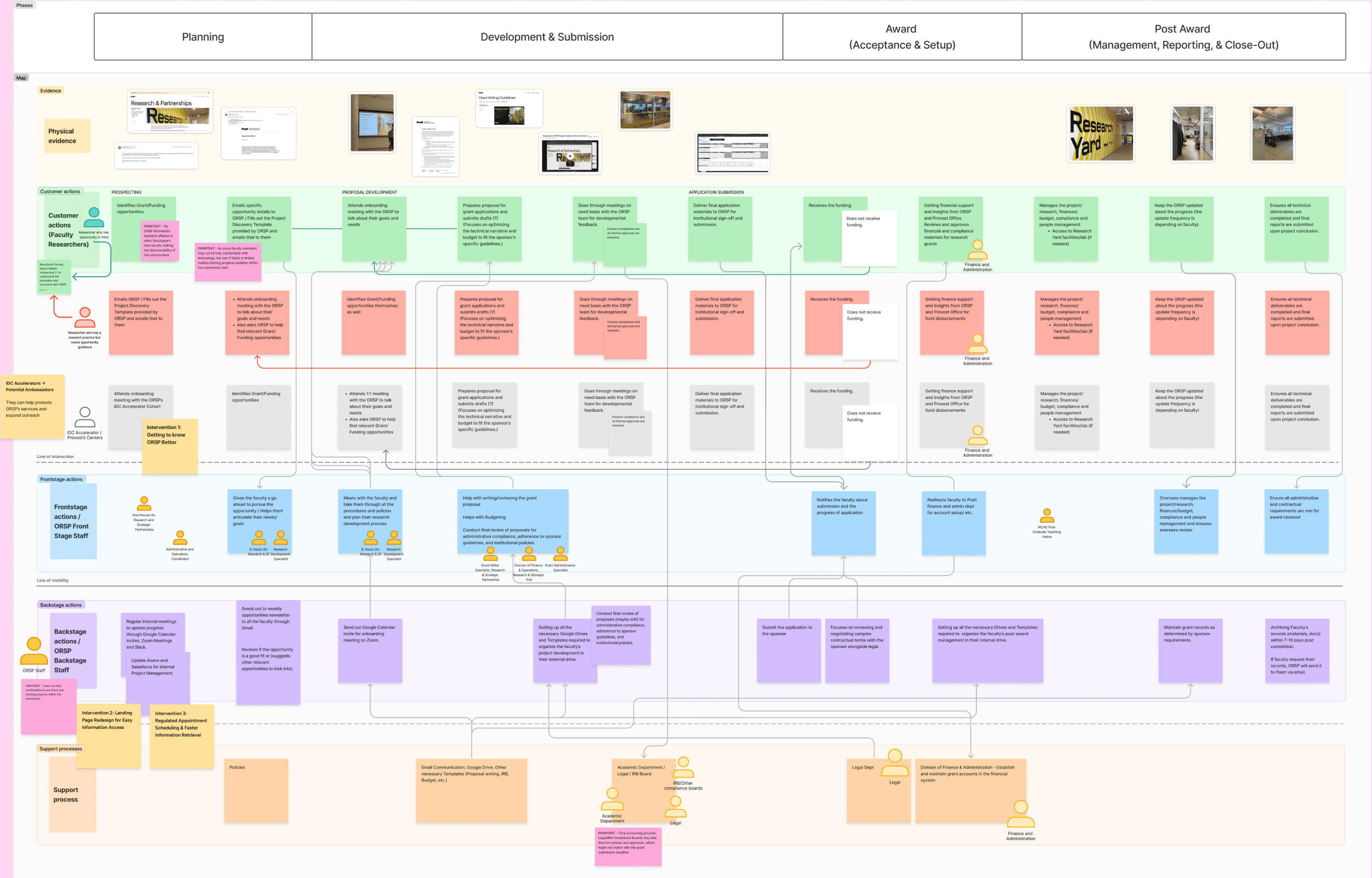
Service Blueprint
The service blueprint maps key touchpoints, pain points, and opportunities across the faculty research journey. It provides a high-level view of where communication can be strengthened and highlights areas for future interventions and improvements.
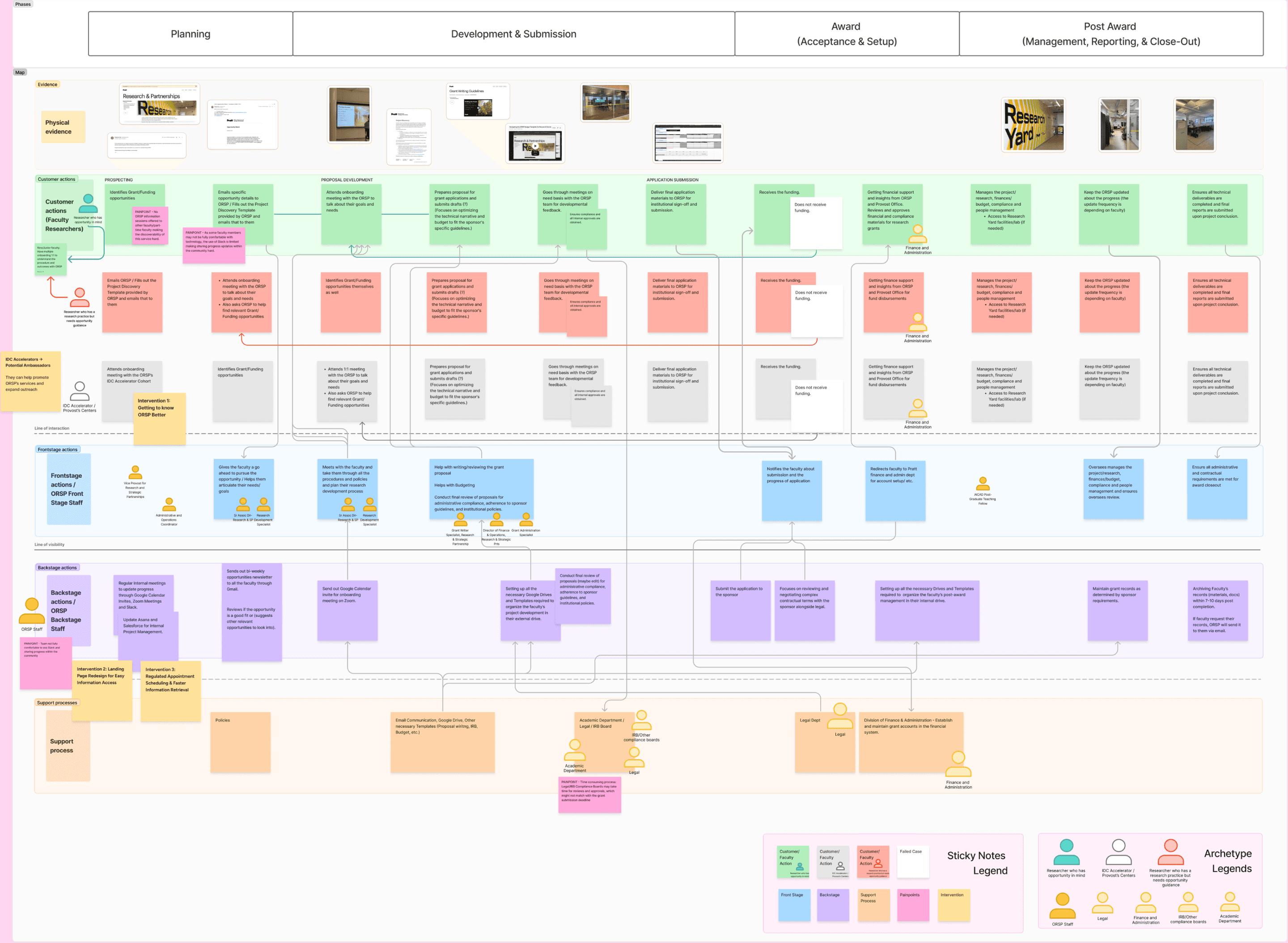
Service Blueprint
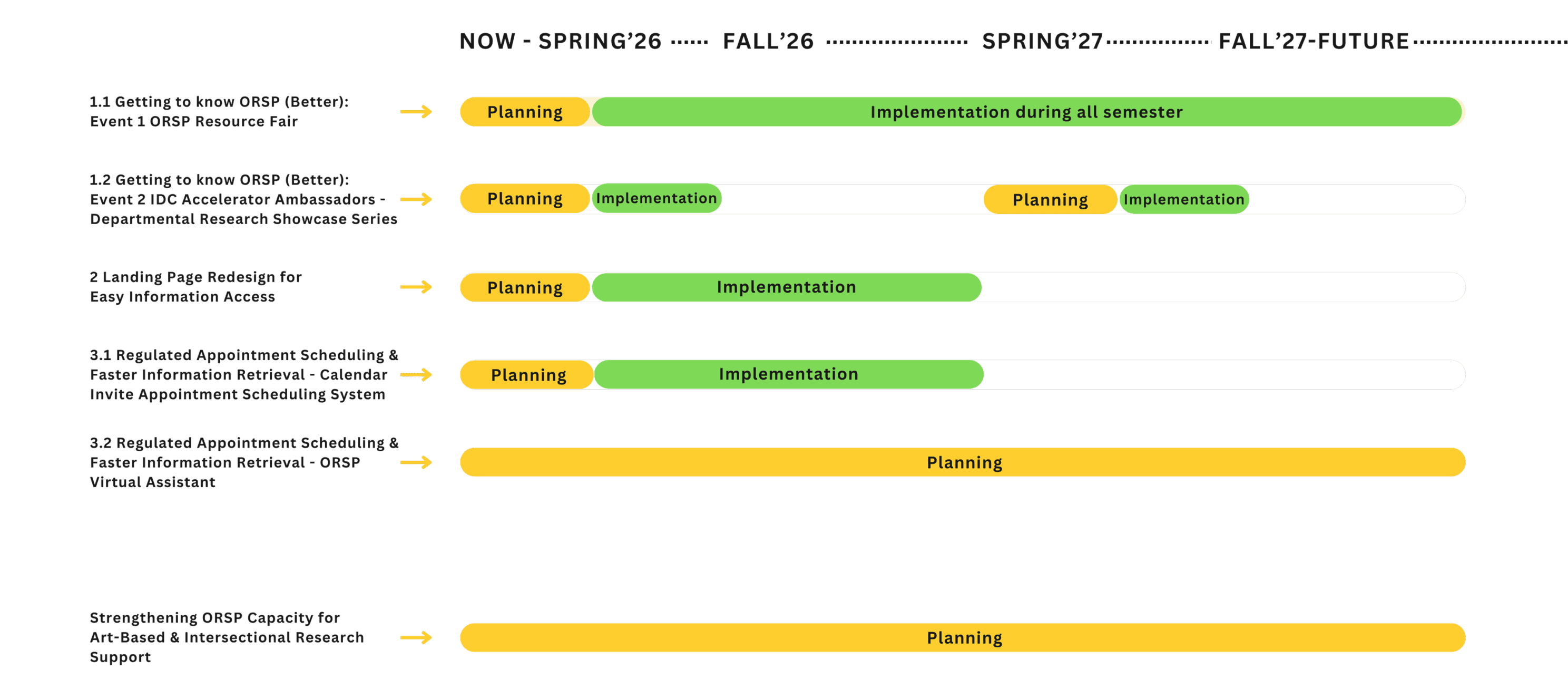
Proposed Project plan
The Gantt chart presents a clear timeline for each intervention, helping ORSP coordinate execution and track progress efficiently.
Reactions & Feedback
Client Feedback
After 9 weeks of research, we presented our findings to ORSP leadership, highlighting actionable interventions to improve faculty communication and support across Pratt’s research ecosystem. While some recommendations differed from current practices, the team appreciated our end-to-end mapping of faculty needs and valued our contributions to strengthening ORSP’s processes and visibility.
“We valued how the team mapped our processes end-to-end, capturing faculty needs and the full research journey. The interventions provide clear, actionable ways to connect with faculty and strengthen the support we offer at every stage.”
- ORSP Admin and Ops Coordinator
Project Takeaways
Working on this project was my first experience applying service design to a complex research ecosystem, and it taught me the value of mapping the entire user journey before proposing solutions. I realized how diverse faculty needs can be and how important it is to create interventions that are flexible and user-centered. Engaging directly with faculty through co-design not only grounded our ideas in real experiences but also highlighted opportunities we might have overlooked. Overall, it reinforced for me how collaboration, observation, and iterative thinking are key to designing meaningful, impactful services.