
Understanding mobility across age groups and what it actually takes to design Voice AI for real people in real cities.
ROLE
UX Researcher
TEAM
UX Researchers - Conor Mack & Eric Lopez
DURATION
3 Months (Feb 26 - May 26)
TOOLS
CustomGPT (ChatGPT), Zapier, Google Sheets, FigJam, Miro, G-Suite
RESPONSIBILITIES
Research Recruitment, CustomGPT Build, Synthesis, Design Guidelines, Presentation Narrative
Context
The upcoming "Silver Tsunami" in NYC
New York City is getting older, faster. Adults 65 and over already represent nearly 45% of the city's pedestrian fatalities, and the population driving that number is only growing.
16.6%
of NYC's population is 65+
1.55M
New Yorkers 62+, up 50% in two decades
~45%
of pedestrian fatalities are adults 65+
At the same time, the MTA is consolidating public transit into a single digital platform, and voice AI is already embedded in city life through Accessible Pedestrian Signals and AI companions like ElliQ. The accessibility conversation in urban mobility is still mostly about physical infrastructure like curb cuts, crossing times, ADA stations. We wanted to know what the next, conversational frontier needed to look like.
We wanted to know what the next, conversational frontier needed to look like.
Research Focus
How can voice AI help older adults navigate physical spaces with reduced cognitive fatigue, while preserving independence and awareness?
The Instrument
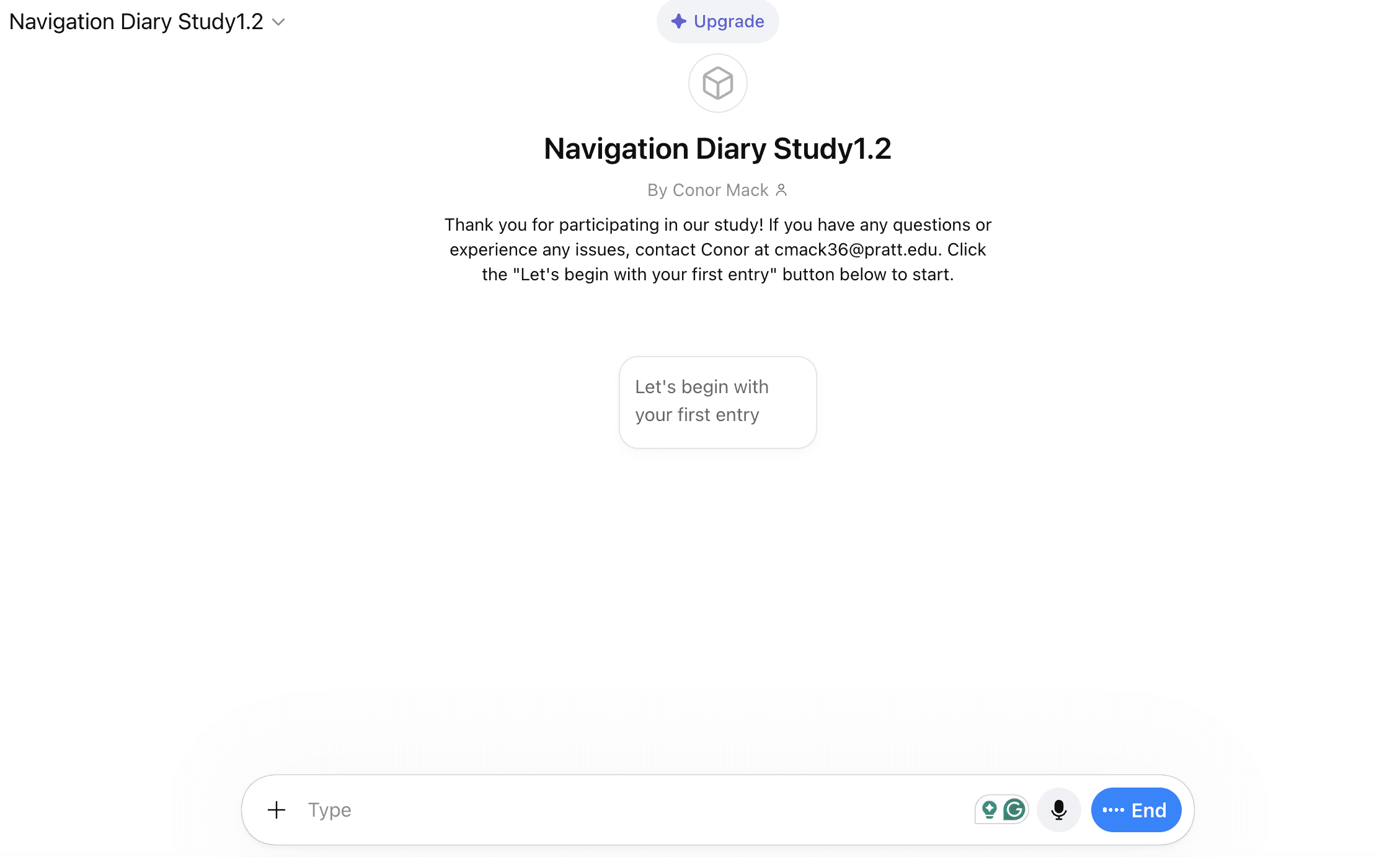
We built the study into the conversation itself
Public, conversational AI interactions don't happen frequently enough to observe directly, and asking someone to reflect afterward loses whatever made the moment real. If we wanted to understand how people actually interact with voice AI during real navigation, we needed to be inside the conversation when it happened rather than reflecting on it later.
So we built a CustomGPT that served three roles inside a single, continuous thread all in one place:
Wayfinding mode
Participant opens the chat and asks for help getting somewhere. The assistant behaves like a normal navigation companion.
Reflection mode
After task based scenarios, the prompt shifts the same conversation into a short set of built-in reflection questions.
Scratchpad
A running scratchpad logs ratings, timestamps, and interpretive notes behind the scenes, invisible to the participant.
Auto-export
Saying "Submit Entry" triggers a Zapier automation that pushes the structured entry straight into our master Google Sheet.
Getting the transition between modes 1 and 2 to feel natural took several rounds of prompt iteration. The system needed to recognize when a trip had actually concluded from conversational cues alone, rather than waiting for an explicit command, or the reflection questions would land as an interruption instead of a continuation of the same conversation.
The Study
From the participant's side
They were just talking to a travel companion that helped plan errands and occasionally asked how it went. The reflection happened inside the interaction, facilitated by the same voice that had just helped plan the route — closing a gap that conventional diary studies can't.
We recruited six participants across age groups and technology comfort levels, from a 25-year-old comfortable with AI tools to a 70+ year-old who had never used a voice assistant for navigation, screening for their familiarity with ChatGPT and caregiving responsibilities before onboarding.
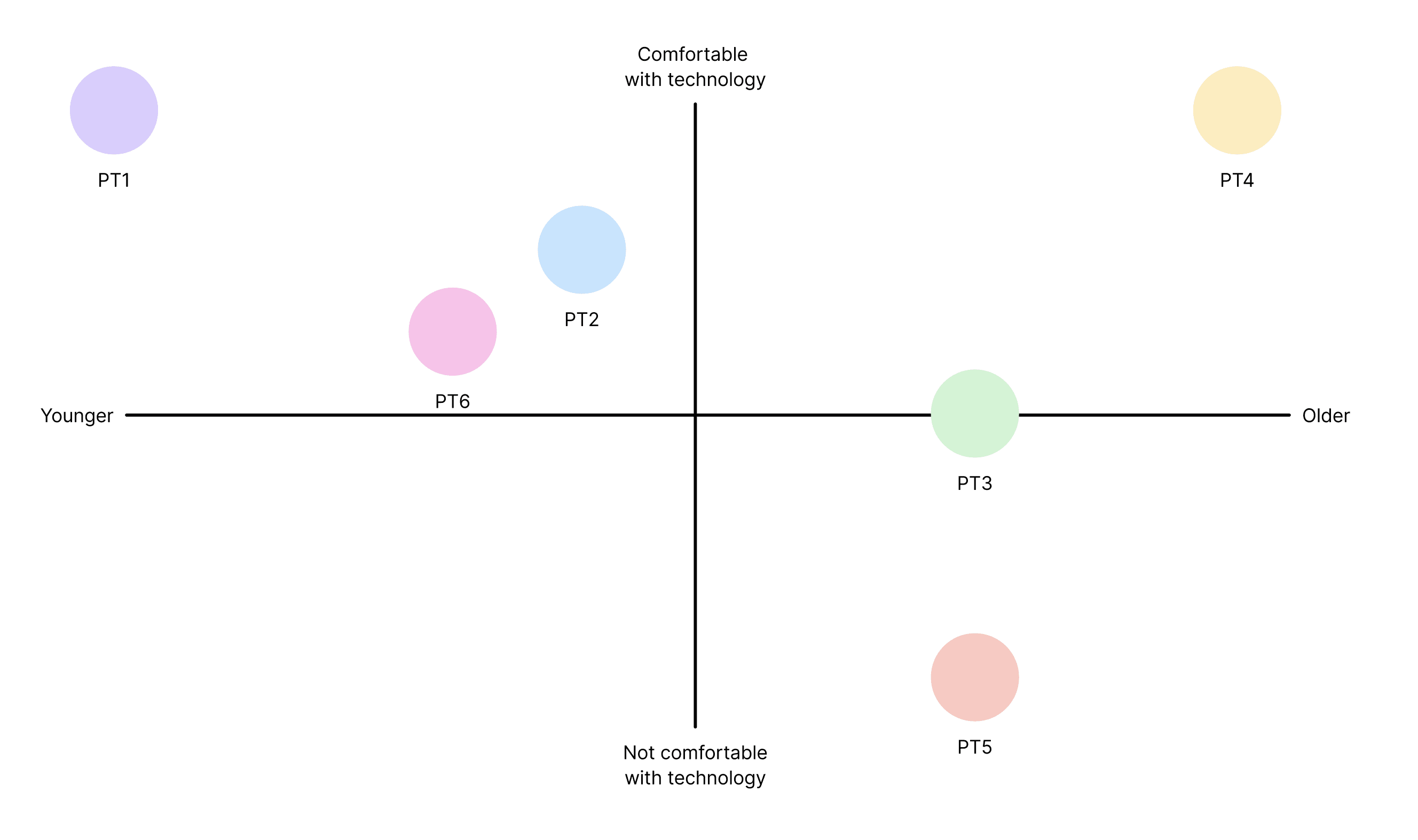
Participant recruited and their relationship with technology (ChatGPT)
What We Found
Six insights from the transcripts
Navigation is the last step, not the first
People opened with an activity, not a destination — the route came last. Leading with "where to?" is already a step behind.
Navigation is social orchestration
Most trips were planned around a group. The destination was secondary to who'd be there.
Landmarks beat coordinates
Street names and distances caused friction every time. People are often to remember landmarks.
"When you said Ohio Street, I was just like, what? I don't know where that is."
Autonomy is non-negotiable
Decisions couldn't be delegated as compared to discovery. Trust dropped the moment the assistant chose for someone.
"Let me just try it first, okay, and then you can correct me or whatever."
Brevity is a safety requirement
The assistant being over-accommodating through responses was frowned upon.
"I think you were just rambling. I would have liked a quick response."
Trust runs in reverse
"Let me just try it first, okay, and then you can correct me or whatever."
Design Guidelines
Turning the insights into 3 principles guidelines
We distilled the findings into ten guidelines for voice AI navigation design: some tactical, like speaking landmark language instead of coordinates, or shortlisting options instead of deciding for someone. Others were more structural, like designing the exit as carefully as the task, and earning the right to speak by staying silent when there's nothing useful to add. All ten trace back to three principles.
Autonomy
The AI assists; the human always leads.
Trust
Earned through accurate information.
Personalization
The AI speaks your language and cater to your preferences.
Reactions & Feedback
Client Feedback
After 3 months of research, findings were presented to the Toyota Woven City, discussing technical feasibility and the strengths-weakness of the study, especially with regards to the study instrument setup. Although we took a very experimental approach with regards to ethnography and research in general, the client was impressed and appreciated our contributions towards scaling their research practices.
“You guys took on an interesting challenge with AI in the intersection of UX research and showed us how feasible it can be for our company to try it out. The findings really help us see we can prepare better and scale our practice here”
- UX Researcher at Toyota Woven
Project Takeaways
Building the diary study tool changed how I think about research design.
Every decision about how the CustomGPT prompted participants, when it shifted into reflection mode, how it handled an incomplete entry, was a UX decision with real consequences for data quality. The instrument and the study were the same thing. That’s not how research usually works, and getting it right required treating the tool with the same rigor we’d bring to any product.
Conversation and language became the biggest priority in setting the study up for success
Users needed to feel heard and validated ; not interrupted, not redirected. The moment the AI took the lead, people pulled back. Control had to stay with the user, not the tool.
For Woven City and the future of urban mobility
More broadly, these findings point to a design opportunity that goes well beyond accessibility features: building AI systems that treat navigation as a human experience: social, landmark-anchored, autonomy-driven rather than a routing problem to be solved.